
SpinFever KYC: Documents, Checks and Withdrawal Verification
 Available in US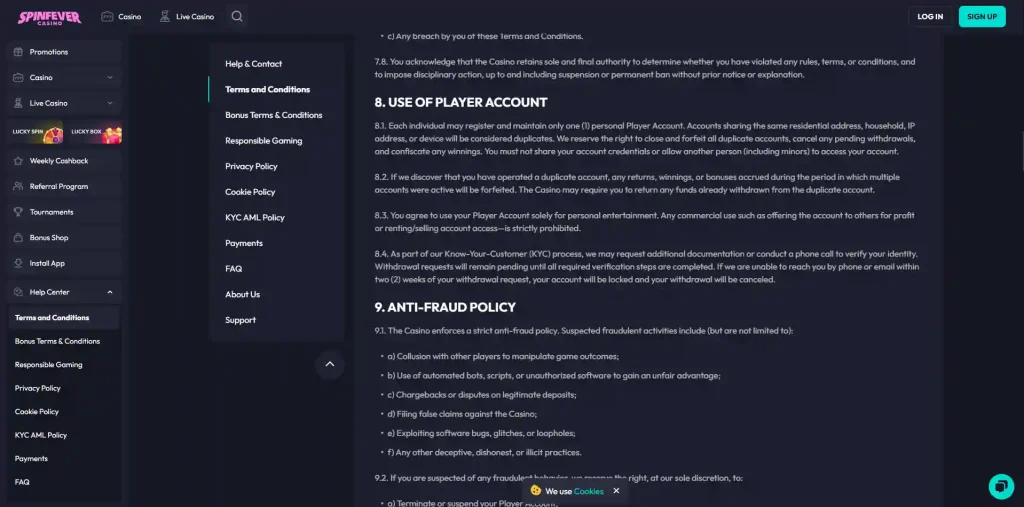
SpinFever’s current official terms support three core KYC evidence categories: government-issued photo identification, proof of address, and payment-method or other additional documentation when requested. The terms also allow further identity checks, including phone verification and, in specified document circumstances, video verification. A withdrawal can remain pending while required verification is incomplete.
The current terms do not establish a fixed standard KYC processing time, so no set number of hours or days can be treated as guaranteed. Focus first on whether the requested documents are valid, current and consistent with the account details.
KYC and withdrawal-verification information current to 10 September 2026.
Table of Contents
- SpinFever KYC documents at a glance
- Government photo ID: identity and eligible age
- Proof of address: confirming the residential record
- Payment-method evidence can connect KYC to withdrawals
- Phone and video verification are conditional checks
- How KYC can affect a withdrawal
- No guaranteed standard KYC completion deadline
- Practical KYC checklist
- If verification becomes a dispute
- What SpinFever KYC requires before withdrawals
- Document consistency matters more than sending extra files
- How to respond to an additional verification step
- References
- SpinFever Bonus Australia: Welcome Offer and Key Terms
SpinFever KYC documents at a glance
| Evidence category | Verified examples | What it is used to establish |
|---|---|---|
| Government photo ID | Passport or driver’s licence are named examples in the current terms | Identity and age |
| Proof of address | Utility bill or bank statement are named examples in the current terms | Current residential address |
| Payment-method evidence | Card or e-wallet evidence can be requested | Connection between the account holder and the payment method |
| Additional checks | Phone verification can be required; video verification can apply in specific document circumstances | Further identity confirmation when document checks are not sufficient |
This is a baseline, not a promise that every account will receive the same request. Current terms allow additional information or documents where needed to confirm identity, eligibility or a payment method.
Government photo ID: identity and eligible age
The current terms list government-issued photo identification and give passport and driver’s licence as examples. Registration terms also connect date of birth with valid identification showing that the account holder meets the applicable age requirement.
The practical point is consistency. The name and date of birth on the account should align with the identity document used for verification. KYC is not just a picture-upload exercise. It is a cross-check between the account record and evidence that belongs to the account holder.
If the question is what information is collected at account creation rather than what documents can later be requested, the registration and account rules page keeps that distinction clear.
Proof of address: confirming the residential record
Proof of address is a separate verified category. The current terms name a utility bill or bank statement as examples. This evidence is used to support the residential address attached to the player account rather than the identity photo itself.
A common verification problem is not the document type but inconsistency between records. If the account contains an old address while the supplied document shows a new one, the operator can ask for clarification or additional information. The safest approach is to keep the account record accurate rather than trying to make a later document fit an outdated profile.
The current published requirements name specific proof-of-address examples and allow the operator to request additional evidence; they do not provide an unlimited catalogue of accepted documents.
Payment-method evidence can connect KYC to withdrawals
SpinFever’s current terms allow proof of payment method or other additional documentation to be requested. That matters because the same terms require deposits to come from a payment account registered in the player’s own name. KYC can therefore involve more than proving who you are; it can also involve confirming that the funding route belongs to the same account holder.
This is where account verification and cashout overlap. The current withdrawal terms allow identity verification before a payout is processed and state that a withdrawal can remain pending until required verification steps are completed. For exact withdrawal minimums, rolling limits and processing statements, use the cashout and KYC rather than duplicating those figures here.
Phone and video verification are conditional checks
The current 2026 terms say SpinFever can conduct a phone call to verify identity as part of its KYC process. They also describe live phone verification in anti-fraud checks. A phone call is therefore a conditional verification tool, not a mandatory interview for every account.
The terms also describe video verification where documents cannot be provided in the requested scripts, with the verification showing the account holder with identification and stating identifying information. This is also conditional rather than a baseline KYC step for every account.
How KYC can affect a withdrawal
The clearest operational consequence in the current terms is that withdrawal requests may remain pending until required verification is complete. That means a payout delay can be an account-verification issue even when the selected payment method itself is working.
When a withdrawal stalls, separate the stages. First identify whether SpinFever has requested documents or another identity check. If it has, the useful next action is to resolve that request rather than repeatedly changing the withdrawal method. Once verification is complete, the cashout page’s separate processing and payment-rail rules become relevant.
KYC can also intersect with duplicate-account and anti-fraud checks. The current terms apply a one-account rule and allow further identity verification where the operator suspects account or payment inconsistencies. That makes accurate registration data and own-name payment methods practical prevention steps rather than administrative detail.
No guaranteed standard KYC completion deadline
KYC timing can vary, and the current terms do not provide a fixed general completion time. A single number could therefore be mistaken for a guaranteed service level.
For decision-making, distinguish between document quality and elapsed time. Valid, readable and consistent evidence addresses the part the account holder can control. The remaining processing time depends on the operator and should be checked against current official KYC information if timing matters for a specific case.
Practical KYC checklist
- Check the request itself. Identify whether SpinFever is asking for identity, address, payment-method evidence or an additional check.
- Match the account record. Confirm that legal name, date of birth and address are consistent with the evidence being supplied.
- Use current valid documents. Avoid relying on expired identity evidence or records that do not reflect the account details.
- Keep payment ownership consistent. The current terms require deposits from payment accounts in the player’s own name.
- Do not assume phone or video is universal. These are conditional checks under the current terms.
- Do not assume a guaranteed KYC duration. The current terms do not state a fixed completion promise.
- Keep records of requests and responses. If an issue later becomes a dispute, dates and the exact evidence requested are more useful than a vague memory of the process.
If verification becomes a dispute
A KYC request is not automatically a complaint. Start by identifying exactly what evidence is outstanding and whether the operator has explained the requirement. If the issue becomes an unresolved dispute rather than a routine verification step, document the chronology, the documents requested, submission dates and support responses.
The dedicated complaint escalation page covers the current complaint route and evidence limits. Australian regulatory status is a separate question again, covered on the licence and legal status page. Neither page should be used to imply that Australian regulator consumer-protection schemes cover SpinFever players.
What SpinFever KYC requires before withdrawals
The baseline requirements are straightforward: government photo ID, proof of address and, when requested, payment-method or additional evidence. Current terms also permit conditional phone and video verification. Withdrawals can remain pending until required checks are complete, so KYC can be a direct part of the cashout process.
The key limitation is timing: the current terms do not provide a guaranteed hours-or-days completion promise. Focus instead on the exact evidence requested, consistency with the account record and whether the verification step is complete. For the broader brand context, return to the SpinFever Australia review.
Document consistency matters more than sending extra files
The three baseline categories solve different parts of the identity check. Photo ID supports identity and age, proof of address supports the residential record, and payment-method documentation can help connect the funding source to the same account holder. Sending several documents that contradict one another does not strengthen the check; consistency between the account record and the requested document is more useful.
Before submitting anything, compare the legal name, date of birth and address on the account with the information visible on the document. If an address has changed or a document has expired, the mismatch itself can become the reason for an additional question. The practical goal is not to send the largest possible document bundle but to answer the exact request with current, readable information that belongs to the account holder.
How to respond to an additional verification step
Phone or video verification should be treated as an escalation path rather than proof that the ordinary document check has failed. When an additional step is requested, first identify what the operator is trying to confirm: identity, document authenticity, account ownership or a payment-method connection. Then follow the stated request without adding unrelated sensitive material.
Keep a record of the request, the date of submission and any reply. If the same issue later affects a withdrawal or turns into a complaint, a clear chronology makes it easier to distinguish an outstanding KYC requirement from a separate payment-processing delay.
References
SpinFever Bonus Australia: Welcome Offer and Key Terms

SpinFever Pokies Australia: Games, Providers and Restrictions
SpinFever has a large casino catalogue that spans thousands of games rather than a small...

Is SpinFever Legal in Australia? Licence, ACMA and Player Protection
No Spin Fever or Novatrix entry was found in the Australian Communications and Media Authority...

SpinFever Payment Methods Australia: Deposits, AUD and Crypto
SpinFever supports Australian dollars and its verified payment mix covers four broad families: cards, bank...

SpinFever App Australia: Mobile Browser and Home-Screen Install
The verified SpinFever mobile setup is browser based with an "Add to Home Screen" installation...

SpinFever Bonus Australia: Welcome Offer and Key Terms
The current Australian-facing SpinFever welcome package is up to AUD 4,000 plus 4 Gold Spins...

SpinFever Registration Australia: Account Setup and Verification Basics
Creating a SpinFever account requires more than choosing login details. Current terms require age and...