
SpinFever Complaints: Withdrawal Issues, Disputes and Risk Signals
 Available in US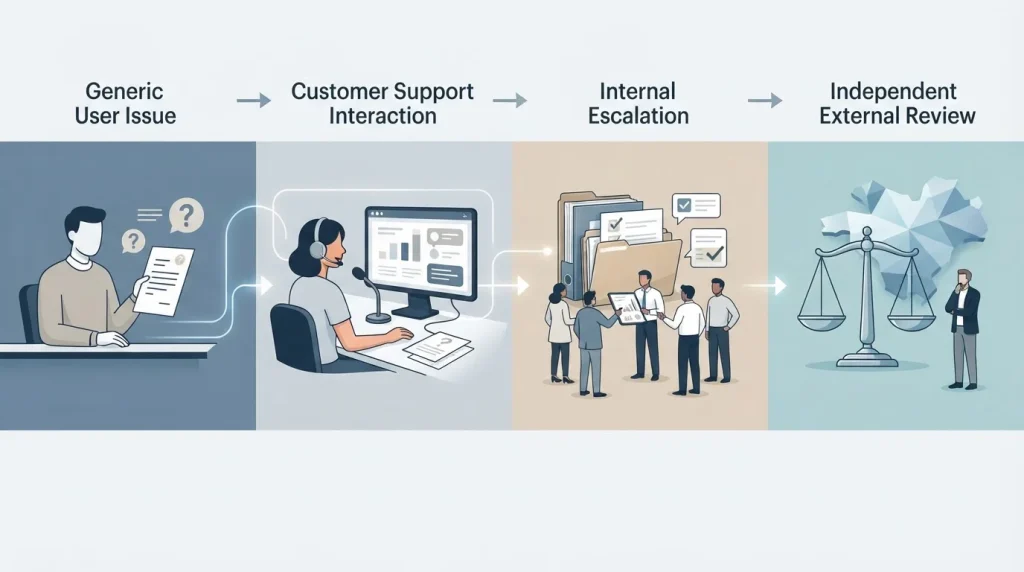
SpinFever complaints should be read as dispute evidence, not as automatic proof that the casino is a scam or that every player will have the same experience. On 10 September 2026, Casino Guru’s current Spin Fever review displayed 28 complaint cases: 1 open, 14 resolved, 13 rejected and none marked unresolved. The visible complaint titles include withdrawal delays or declines, verification-linked withdrawal problems, bonus disputes and account-closure issues.
The status mix matters as much as the raw count. A resolved case is not the same as an open allegation, and a rejected case should not be presented as an established finding against the casino. SpinFever’s current terms also set out a separate formal route: complaints start with Support, can be escalated internally and, if the customer remains dissatisfied, the terms name EGIS as the stated independent ADR body under the Tobique framework. That is not an Australian regulator dispute scheme.
Complaint database and official-terms information current to 10 September 2026.
Table of Contents
- Current SpinFever complaint snapshot
- What themes are visible in the complaint list?
- Withdrawal complaints: check the mechanics before judging the outcome
- Verification disputes need their own evidence trail
- Bonus and account-closure complaints: separate the allegation from the rule
- SpinFever’s official complaint and escalation route
- EGIS and Australian regulatory protections are separate
- How to assess a SpinFever complaint before relying on it
- What the current SpinFever complaint record actually shows
- References
- SpinFever Payment Methods Australia: Deposits, AUD and Crypto
Current SpinFever complaint snapshot
Casino Guru is a third-party complaint and review service rather than a court, regulator or SpinFever’s own support system. Its database is useful because it exposes complaint statuses and case titles in one place, but the numbers are dynamic and should be dated whenever they are used.
| Database status | Cases shown on 10 September 2026 | How to read it |
|---|---|---|
| All | 28 | The total shown in the current Spin Fever complaint table. |
| Open | 1 | A case still shown as active in the complaint system. |
| Unresolved | 0 | No case was carrying this status in the current snapshot. |
| Resolved | 14 | Cases the database classifies as resolved rather than still open. |
| Rejected | 13 | Cases rejected within the complaint service’s own process; the label should not be rewritten as a legal finding. |
The useful signal is therefore not “28 complaints means wrongdoing”. The more disciplined reading is that there is a visible history of disputes, with a mixed outcome profile. For risk assessment, the next question is what those disputes are about and whether the same mechanics can be checked against current terms.
What themes are visible in the complaint list?
The current visible complaint titles on Casino Guru include delayed or declined withdrawals, withdrawals held up by verification, a withdrawal reduced in connection with a bonus issue, bonus-claim disputes and account closures connected with withdrawal attempts or persistent complaints. These titles are allegations or case summaries on a third-party platform. They are not proof that every event happened exactly as alleged and they do not establish a general pattern of non-payment.
Still, the themes are decision-relevant because several of them map to rules that SpinFever currently publishes itself. Withdrawal disputes can intersect with wagering conditions. Verification disputes can intersect with KYC holds. Bonus disputes can turn on separate bonus conditions. Account-closure complaints can involve facts that are impossible to assess from a title alone, such as account history, verification records or the rule the operator says was breached.
Withdrawal complaints: check the mechanics before judging the outcome
SpinFever’s current terms require each cash deposit to be wagered three times before those deposited funds can be withdrawn. The same terms also allow KYC checks to hold a withdrawal until required verification steps are completed. Both rules are current to 10 September 2026.
Those rules do not prove that a particular delayed or declined withdrawal was handled correctly. They do explain why a useful complaint review needs more than the phrase “withdrawal delayed”. The key questions are whether the account had completed the applicable cash-deposit wagering, whether verification was requested, whether the requested evidence was supplied, and what reason the operator gave for the decision.
For the current cashout limits and processing mechanics, use the separate withdrawal rules page. It keeps the high-freshness numbers and timing details in one place rather than duplicating them here. The broader payment methods covers funding methods and AUD payment context.
Verification disputes need their own evidence trail
Verification appears directly in some of the current complaint titles, and SpinFever’s own terms confirm that KYC can keep a withdrawal pending while identity checks are incomplete. That makes verification a real dispute mechanism rather than a topic inferred only from reviews.
The important distinction is between the existence of a KYC requirement and the fairness of a specific verification request. A complaint may involve document quality, mismatched account information, payment ownership, repeated requests, a communication delay or another case-specific issue. A short public complaint title rarely contains enough evidence to decide which explanation is correct.
The KYC verification covers the currently verified identity-check process and the evidence types stated in official material. This complaints page does not repeat fixed verification-time claims or turn a player’s account of a KYC delay into a general performance statistic.
Bonus and account-closure complaints: separate the allegation from the rule
The visible complaint set also includes bonus-related disputes and account-closure cases. These are especially easy to overstate because the outcome can depend on the exact promotion accepted, the version of the bonus terms in force, betting behaviour, duplicate-account checks, payment history or another account-level fact not visible in a headline.
A rejected third-party complaint does not by itself prove the player acted improperly, just as an open complaint does not prove the casino acted improperly. The database status tells you where the complaint service placed the case in its own process. A sound risk assessment therefore treats each case as evidence with a status, not as a testimonial that can be copied into a blanket judgment.
The available complaint data supports saying disputes exist and identifying the issues visible in the current complaint list, but it does not support a general fraud finding or a blanket label such as “SpinFever scam”.
SpinFever’s official complaint and escalation route
SpinFever’s current Terms and Conditions contain a dedicated complaints section. It says complaints are initially handled by the Support Team. If Support cannot resolve the issue immediately, the matter is escalated within the casino’s organisational structure, with the customer kept reasonably informed about the complaint status.
The terms then provide an ADR step. If the customer is dissatisfied with the internal outcome, SpinFever states that the matter can be escalated to EGIS, which the terms describe as an independent ADR body operating under Tobique Gaming Commission regulations.
- Raise the issue with SpinFever Support and keep the case or conversation reference.
- Provide the transaction IDs, dates, account details and requested verification evidence relevant to the dispute.
- Ask for the issue to be escalated internally if first-line Support does not resolve it.
- Keep the operator’s written final position and the terms or promotion wording that applied at the time.
- If the internal process is exhausted, review the EGIS route stated in the current SpinFever terms.
This sequence is practical documentation advice, not a guarantee that a dispute will be resolved in the player’s favour.
EGIS and Australian regulatory protections are separate
SpinFever’s terms identify EGIS as the external ADR route under the Tobique framework. That route should be assessed as the dispute mechanism named by the operator, not as an Australian statutory process.
It should not be described as an Australian statutory dispute scheme or ACMA process. The full Australian regulatory status page covers licensing and enforcement separately from complaint handling.
For an Australian reader, this distinction is a meaningful risk signal. A complaint process can exist without being the same as the dispute and consumer-protection mechanisms attached to an Australian licensed wagering provider.
How to assess a SpinFever complaint before relying on it
Start with the date. A complaint can refer to an older operator, older terms, a payment method that has changed or a promotion that no longer exists. Next, read the final status rather than stopping at the allegation. Then identify the disputed mechanism: withdrawal, verification, bonus, account closure or payment processing.
For a withdrawal case, compare the claim with the current or historical withdrawal rules. For a verification case, check what evidence was requested and whether the record shows it was supplied. For a bonus case, locate the exact promotion terms rather than relying on a generic bonus page. For an account closure, look for the operator’s stated reason and any evidence supporting or challenging it.
Finally, separate three questions that are often mixed together: “Did this player report a dispute?”, “How did the complaint platform classify the outcome?” and “What do the operator’s terms and regulator records independently establish?” Keeping those questions separate produces a more reliable risk assessment than counting negative headlines.
What the current SpinFever complaint record actually shows
The current third-party snapshot shows 28 complaint cases with 14 resolved, 13 rejected, 1 open and 0 unresolved. The visible case titles include withdrawal, verification, bonus and account-closure themes. That is enough to justify reviewing dispute mechanics carefully, but it is not enough to label SpinFever fraudulent or non-paying as a general fact.
The stronger evidence comes from combining complaint status with current official rules. SpinFever’s terms confirm that KYC can hold withdrawals, deposited funds carry a three-times wagering condition before withdrawal, complaints begin with Support and can be escalated internally, and the stated ADR route is EGIS under the Tobique framework. For Australian readers, that offshore route must be kept distinct from Australian licensed-wagering protection.
Use the SpinFever Australia review for the overall product assessment, then use the dedicated withdrawal, KYC and regulatory pages when a complaint turns on one of those specific mechanisms.
References
SpinFever Payment Methods Australia: Deposits, AUD and Crypto

SpinFever Pokies Australia: Games, Providers and Restrictions
SpinFever has a large casino catalogue that spans thousands of games rather than a small...

Is SpinFever Legal in Australia? Licence, ACMA and Player Protection
No Spin Fever or Novatrix entry was found in the Australian Communications and Media Authority...

SpinFever Payment Methods Australia: Deposits, AUD and Crypto
SpinFever supports Australian dollars and its verified payment mix covers four broad families: cards, bank...

SpinFever App Australia: Mobile Browser and Home-Screen Install
The verified SpinFever mobile setup is browser based with an "Add to Home Screen" installation...

SpinFever Bonus Australia: Welcome Offer and Key Terms
The current Australian-facing SpinFever welcome package is up to AUD 4,000 plus 4 Gold Spins...

SpinFever Registration Australia: Account Setup and Verification Basics
Creating a SpinFever account requires more than choosing login details. Current terms require age and...