
SpinFever Registration Australia: Account Setup and Verification Basics
 Available in US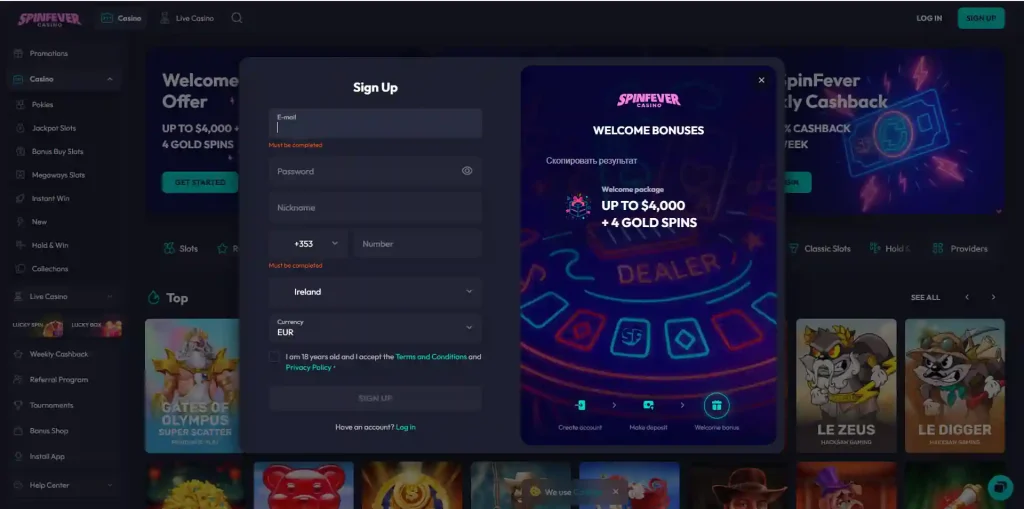
Creating a SpinFever account requires more than choosing login details. Current terms require age and identity information including date of birth, legal name, residential address and a valid email address, with identity and address documents available for verification. SpinFever also applies a one-person, one-account rule and can request additional checks before an account or withdrawal proceeds.
The site currently exposes an English-Australia version and Australian-facing sign-up entry points, but that does not mean SpinFever is authorised as an online casino in Australia. The Australian Communications and Media Authority states that providers must not offer online casino services to people in Australia under the Interactive Gambling Act. Treat registration visibility and Australian legal authorisation as separate questions.
Registration, KYC and Australian legal information current to 10 September 2026.
Table of Contents
- What SpinFever asks an account holder to provide
- The one-account rule matters before registration
- Use accurate personal details from the start
- Payment accounts should be in the account holder’s name
- Australian sign-up visibility and regulatory status are separate
- Support is part of account readiness
- Pre-registration risk checklist
- Limits of registration availability
- What SpinFever registration requires in practice
- Shared households and devices need extra care
- Checks to make before the first deposit
- If account details need correction
- References
- SpinFever Registration Australia: Account Setup and Verification Basics
What SpinFever asks an account holder to provide
The current terms identify the core registration and verification data as date of birth with evidence of eligible age, full legal name, full residential address and a valid email address. The same terms also describe government-issued photo identification and proof of address as part of the identity-verification framework, with extra information or documents possible when the operator needs to confirm identity or a payment method.
This is why it is more accurate to think of registration as the start of an identity-linked account rather than a disposable username. Personal details entered at account creation can later be compared with documents and payment information. Inaccurate or inconsistent details can therefore create verification problems that are separate from whether a deposit or game itself works.
The one-account rule matters before registration
SpinFever’s current terms say each individual may register and maintain only one personal player account. They also treat accounts sharing a residential address, household, IP address or device as potential duplicates under the stated duplicate-account rule. That makes account history part of registration readiness, especially in a shared home or on a shared device.
A practical pre-registration check is therefore to establish whether you already have an account, including one created earlier and then forgotten. Creating another account to solve a login problem can turn an access issue into a duplicate-account issue. If credentials are the problem, using support is safer than creating a second profile.
This rule also explains why the site should not be read as a casual multi-profile service. The account is intended for one natural person, and the current terms prohibit sharing credentials or allowing another person to use the account.
Use accurate personal details from the start
The most useful registration advice is not a click-by-click sign-up walkthrough because interface fields can change. The durable requirement is that the account information should match the account holder’s real identity and current address. Current terms connect verification to legal name, date of birth, residential address, email and identity documents.
If a name is entered differently from the identity document, or an old address is used while current proof of address shows something else, verification can become harder. The same logic applies to contact information. A valid email address is part of the required account data, and current terms allow the operator to use email and phone contact during verification-related processes.
For a reader comparing operators, this is a more meaningful registration criterion than the number of form fields. A short form does not mean a low-verification account. The important question is what information the operator can require before withdrawals or continued account access.
Payment accounts should be in the account holder’s name
Current SpinFever terms require deposits to come from a bank account, card, e-wallet or other payment account registered in the player’s own name. That links registration identity to the funding method. Using another person’s payment account is not simply a payment preference under the terms; it creates a mismatch with the stated account rules.
Before funding an account, check the verified payment methods rather than assuming every Australian payment rail is available. The payments guide separates broad supported families from methods that were not specifically verified for SpinFever. If the later issue is cashing out, the withdrawal verification explains how KYC and payment review can affect a request.
Australian sign-up visibility and regulatory status are separate
SpinFever currently publishes an English-Australia site version with AUD-facing content and visible registration entry points. Those are observable localisation facts relevant to account setup.
Regulatory and enforcement questions belong on the dedicated trust page rather than in a registration guide.
For that separate context, use the dedicated Australian legal status page rather than treating site access or registration visibility as a regulatory finding.
Support is part of account readiness
SpinFever’s current support page lists 24/7 support and the email address [email protected]. Keeping these details on the account page is more useful than creating a thin standalone support article because account questions often arise before or during verification.
Support is particularly relevant for an existing account, a duplicate-account concern, a mismatch in stored personal information or a verification request that is unclear. A support channel does not override the terms, but it gives the account holder a place to clarify what the operator is requesting instead of opening a second account or guessing at document requirements.
Pre-registration risk checklist
- Existing account: confirm that you do not already have a SpinFever account before creating another one.
- Identity details: use your real legal name, current residential address, date of birth and valid email details.
- Verification readiness: expect identity and address verification to be possible and keep detailed KYC questions for the dedicated verification guide.
- Payment ownership: use payment accounts in the account holder’s own name rather than another person’s card, bank account or wallet.
- Australian context: keep localisation and account mechanics separate from regulatory questions.
- Regulatory context: use the dedicated trust analysis for regulation and enforcement rather than treating operational access as the answer.
Limits of registration availability
Not every Australian applicant is guaranteed acceptance: the current terms include eligibility conditions and verification powers. Registration also does not guarantee that every game, promotion or payment method will be available to an Australian account.
A field-by-field sign-up sequence can change with the interface. The durable requirements are identity-linked account data, the one-account rule, own-name funding and the possibility of deeper verification. Device-specific account access is covered separately in the SpinFever mobile.
What SpinFever registration requires in practice
SpinFever registration is best approached as an identity and account-compliance process rather than a quick form. Current terms connect the account to age evidence, legal name, residential address, email, one-account restrictions and later verification. Payment accounts are also expected to match the account holder’s identity.
For Australians, account mechanics should be considered separately from the broader regulatory context. For the broader brand overview, return to the SpinFever Australia review.
Shared households and devices need extra care
The duplicate-account rule is especially relevant where more than one adult uses the same home internet connection or the same device. The current terms allow shared residential address, household, IP address or device information to be considered when duplicate accounts are assessed. That does not mean every shared household automatically creates a problem, but it makes accurate ownership and account history more important.
Before creating an account on a shared device, check whether your own SpinFever account already exists and avoid using another person’s credentials. If another household member also has an account, keep names, contact details and payment methods clearly tied to the correct person. The practical aim is to reduce ambiguity about who controls each account and which payment source belongs to whom.
If a shared-device situation leads to a question from support, explain the circumstances directly rather than creating another profile. A second account can make the original issue harder to resolve because the terms are built around one personal account per individual.
Checks to make before the first deposit
- Review the personal record. Confirm that the legal name, date of birth, residential address and email are current and match the details you could later support with documents.
- Confirm account history. Make sure an earlier account has not been forgotten, especially if you previously registered with a different email address.
- Use your own payment source. The terms connect deposits with bank accounts, cards, e-wallets or other payment accounts held in the player’s own name.
- Check the actual cashier. A payment category mentioned generally does not guarantee that a specific method will be available for your account at that moment.
- Know where to ask for help. If identity details, account status or a duplicate-account warning are unclear, support is a better next step than opening a replacement account.
These checks do not guarantee acceptance or uninterrupted account access. They simply address the parts of registration that are directly connected to the account holder’s own information and can reduce avoidable inconsistencies before KYC or withdrawal checks begin.
If account details need correction
Identity-linked details should not be treated as disposable profile fields. If the account record no longer matches current information, use the available support route to clarify what can be corrected and what supporting information may be needed. Guessing, opening a second account or using another person’s payment method can create additional inconsistencies instead of fixing the original one.