Casino Dice Games in Australia: Rules and Formats
 Available in AU

Casino dice games vary in how the roll affects a wager, so understanding the rules helps distinguish dice-led play from games with dice as a feature.
Table of Contents
- What Counts as a Casino Dice Game?
- Casino Dice Online: The Australian Legal Picture
- Casino Dice Games: What the Name Covers
- Games With Dice—and Games Where You Roll Them
- Craps: The Dice Table Game
- How to Play Casino Dice Online—Without Guessing the Rules
- Casino Dice Rules: Read the Fine Print First
- Dice Strategy: Keep Risk in View
- Live Dice: What the Format Changes
What Counts as a Casino Dice Game?
A casino dice game is one where dice are part of the mechanism that decides the result. You make a choice or place a wager, dice are rolled, and their face values—or a combination of them—determine what happens next. The important point is that the roll has a direct role in the game’s outcome, rather than being there for atmosphere.
That sounds straightforward, but the label can be slippery. I used to assume that any casino game showing dice counted as a dice game. That is too loose. A game might include dice as a side feature, a visual symbol or one step in a longer sequence without making the roll the central event. Seeing dice on the screen or table does not tell you enough by itself.
A useful test is to ask: if you removed the dice, would the main game still work in essentially the same way? If not, the dice are probably central. If the rest of the game carries on and the dice only affect a small feature, they are a component, not the defining action.
Choosing a casino for dice in Australia in 2026 means checking what is actually known before you play. Use these brief notes to assess each listed operator on the available details.
1. JustCasino
License: Curacao Gaming Control Board JustCasino is listed with a Curaçao Gaming Control Board license. You can use that licensing detail as a starting point when assessing the operator.
2. MrPacho
Payout speed: crypto 30-120 minutes, fiat 24-72 hours · Min. deposit: A$30 MrPacho lists a minimum deposit of A$30. Its stated payout speeds are 30–120 minutes for crypto and 24–72 hours for fiat.
3. Roby Casino
License: Curacao eGaming (Roby Games Ltd) Roby Casino is listed with a Curaçao eGaming license held by Roby Games Ltd. That is the available licensing detail to consider.
4. WinSpirit Casino
License: Curacao eGaming OGL/2024/923/0383 (Antillephone N.V.) · Min. deposit: A$30 WinSpirit Casino lists a Curaçao eGaming OGL/2024/923/0383 license through Antillephone N.V. Its stated minimum deposit is A$30.
5. DragonSlots Casino
License: Curacao Gaming Authority (Jumpman Gaming Ltd) DragonSlots Casino is listed with a Curaçao Gaming Authority license, with Jumpman Gaming Ltd named in connection with it. You can consider this licensing information when reviewing the operator.
6. SpinsUp
License: Curacao Gaming Control Board OGL/2023/174/0082 (Dama N.V.) SpinsUp lists a Curaçao Gaming Control Board OGL/2023/174/0082 license associated with Dama N.V. This is the available detail for your assessment.
7. SkyCrown
License: Tobique Gaming Commission · Payout speed: crypto ~10-15 minutes, fiat 1-5 days · Min. deposit: A$30 SkyCrown lists a Tobique Gaming Commission license and a minimum deposit of A$30. Its stated payout speeds are around 10–15 minutes for crypto and 1–5 days for fiat.
8. Neospin
License: Curacao Gaming Control Board OGL/2023/176/0095 (Hollycorn N.V.) Neospin lists a Curaçao Gaming Control Board OGL/2023/176/0095 license associated with Hollycorn N.V. You can take this licensing detail into account when assessing it.
9. Wild Tokyo
License: Curacao · Payout speed: crypto 30-60 minutes, fiat 1-5 days · Min. deposit: A$10 Wild Tokyo lists a Curaçao license and a minimum deposit of A$10. Its stated payout speeds are 30–60 minutes for crypto and 1–5 days for fiat.
10. Uptown Pokies
License: Curacao (operating since 2017) · Min. deposit: A$20 Uptown Pokies is listed as operating since 2017 under a Curaçao license. Its stated minimum deposit is A$20.
The number of dice is not the deciding factor, either. What matters is how the rules use the roll: whether the result settles a wager, changes the state of the game or triggers another outcome. Two games can both use dice and still feel quite different because one makes the roll the whole event while the other uses it alongside other mechanics.
So, when someone asks what the dice game in a casino is, there is no single answer implied by the phrase. It describes a category, not one universal set of rules. Before assuming you know what a game involves, check what the dice actually decide and how the rules connect that result to your wager.
That small distinction matters. It stops a broad label from doing the explaining for you.
Casino Dice Online: The Australian Legal Picture
A dice game does not sit outside Australian gambling law just because it uses dice rather than cards or a wheel. The key issue is the service being offered: real-money online casino games for people in Australia are prohibited under the Interactive Gambling Act 2001. A casino-style dice game offered online for money can fall within that restriction. Changing the game’s name or presentation does not, by itself, change the legal picture.
I used to think the important distinction was whether a site looked like a familiar casino. That was the wrong test. For Australians, the relevant point is that operators must not provide prohibited online casino services to people physically in the country. The law also covers online casino-style games such as blackjack, roulette, poker and slots; a dice format is not a workaround simply because its mechanics differ.
Best RTP Slots in Australia: What the Figure Means
The restriction is directed at providers, not at players. Australians are not criminalised for using an offshore gambling site. That does not make the service lawful to provide here, or mean it is endorsed or protected locally. It is worth keeping those points separate: a player’s position and an operator’s obligations are not the same thing.
What enforcement looks like
The Australian Communications and Media Authority (ACMA) is the federal regulator responsible for enforcing the Interactive Gambling Act and monitoring compliance with federal interactive-gambling laws. Where a website provides a prohibited service, or advertises one in Australia, ACMA can ask Australian internet service providers to block access to it. A page appearing online is not evidence that it is lawful, permanent or available without interruption.
ACMA reports that it has blocked more than 1,455 illegal gambling and affiliate websites since enforcement actions began in November 2019. That figure includes affiliate sites as well as gambling sites, so it should not be read as a count of dice casinos alone. The regulator has also reported that more than 210 illegal services withdrew from the Australian market after enforcement began in 2017. There is a discrepancy in published figures: another account puts the number of withdrawals at more than 190. The totals differ, so neither should be presented as an exact, settled count.
Blocking is one visible part of enforcement, not a promise that every prohibited site will disappear at once. Sites can change addresses or stop serving particular markets, while enforcement action continues. I would not treat a working link, an Australian payment option or a polished page as proof that an online casino is permitted to serve people here.
Legal Prohibition
Real-money online casino games for people in Australia are prohibited under the Interactive Gambling Act 2001.
Offshore payment options are not approval
Some offshore online casinos accept Australian payments while operating under licences issued outside Australia. That can make them look locally accessible, but accepting a payment does not give an operator permission under Australian law to offer prohibited casino services to Australians. An overseas licence is not an Australian authorisation.
That distinction matters when a site presents familiar currency, payment methods or customer support. Those details may affect how a transaction is handled, but they do not settle whether the underlying service can legally be offered in Australia. Nor do they show that an Australian regulator supervises the service. I have learned to separate “the page lets me proceed” from “this is lawful and locally protected”. They are not the same claim.
This section is about the legal setting, not a route to an offshore service. I’m not going to point you towards one or suggest ways around a block. If a site is restricted, trying another address does not change the law that applies to the operator. And if a service disappears, that is not a reason to follow it elsewhere.
Advertising and the practical takeaway
Advertising prohibited online casino services to Australian audiences is also restricted. That includes promotional material for offshore services; a banner, recommendation or affiliate page does not make the underlying offer legitimate. If you encounter casino dice content online, distinguish general information about a game from an invitation to gamble for money. The format may look similar, but the legal implications are not.
Anyone considering gambling should be at least eighteen. Gambling can cause serious harm, particularly for people who are vulnerable or already struggling to control it. Legal status is not a measure of personal risk, and a site’s availability is not a sign that playing is safe.
Video Slots in Australia: Online Play Explained
The practical point is straightforward: real-money online casino services cannot lawfully be offered to people in Australia, and ACMA can take enforcement steps that include requesting access blocks. Players are not criminalised for using offshore sites, but that does not turn those services into locally authorised casinos. I would not rely on a dice theme, an overseas licence or the ability to make a payment as evidence otherwise.
Casino Dice Games: What the Name Covers
“Casino dice” sounds like the name of one game. It isn’t. It is a loose label people use for different kinds of games connected with casino play and dice. That can mean a familiar table format, a digital game built around dice, or a game where dice are only part of the design. The label alone does not tell you what you would actually see or do.
I used to treat a game’s name as a decent shortcut: if it said “dice”, I assumed I knew the basic shape of it. That was lazy. Two games can share the same broad description and still have different actions, outcomes and rules. The title is a starting point, not a rulebook.
A useful way to read the label is to ask what it describes. Sometimes it refers to the object: dice appear on screen or on a table. Sometimes it points to the main action, with a roll determining what happens next. And sometimes “casino” signals a style or setting rather than a particular format. Those meanings overlap, which is why a short title can leave you with the wrong impression.
Understanding Labels
Terms like "casino dice game" are umbrella terms; you should separate a game’s name, its presentation, and its actual rules to understand how it works.
The word “game” adds little precision. A casino dice game might be a named, established format, or it might be a digital presentation using dice imagery and its own set of outcomes. It might resemble a table game without reproducing the same play. A pair of dice on a screen does not, by itself, tell you whether the game follows a recognised format or uses a different structure.
That distinction matters before you spend time trying to understand a title. Look for the game’s actual name and description, then check whether its display explains the central action. If all you have is a tile with a dramatic picture and a short label, you have branding, not much information. I’ve mistaken the packaging for the game before. It’s an easy trap.
The phrase can also describe a category rather than a single product. A page or menu might group several dice-related titles under one heading, even if they do not play alike. One could be presented as a table experience; another could use a simpler digital layout. The shared category says something about their theme or equipment, not necessarily their pace, decisions or outcome structure.
Pokie Machines to Play in Australia: Legalities and Odds
That is why the wording can shift around: “dice casino game”, “casino game with dice” and “casino dice” may all point to similar material, but none guarantees an identical game. Ordinary language is untidy. A title can be technically accurate and still leave out the detail that would help you identify the format.
If you are trying to work out what a particular title means, separate three things in your mind: its name, its presentation and its rules. The name is the label. The presentation is what the screen or table shows. The rules explain how the game actually works. Only the last of those can settle what the displayed dice mean and what actions are involved. No need to guess.
This broad label can be useful when you are exploring a subject, but it is a poor substitute for a specific description. Treat “casino dice” as an umbrella term. Then narrow it down by identifying the named format and the role dice play in it. That keeps you from assuming that every title with dice in the picture offers the same kind of experience.
The other practical point is that a casino-style label is not proof that a game is available or lawful to play where you live. In Australia, real-money online casino services are prohibited for operators to provide to people in the country. A description on a screen does not change that. If gambling is involved, it is for adults aged eighteen or older, and it can cause serious harm to vulnerable people.
So the phrase gives you a subject area, not a promise about the game. Pin down the format before drawing conclusions from its name. Labels are loose. Rules aren’t.
Games With Dice—and Games Where You Roll Them
A game can include dice without asking you to roll them. That sounds like a small distinction, but it changes what you are actually doing: in one format, dice are just a feature of the game; in another, the roll is the event everything else depends on.
Dice as a Component
Dice are one element of a wider process, such as triggering a stage or determining movement, rather than settling the result alone.
Dice as the Main Event
The roll is the central focus and generates the result the format is built around, such as in Craps or Sic bo.
When I see dice in a casino-style game, I try to pin down their job before anything else. Are they determining the result directly? Are they only one part of a larger set of symbols or actions? Or are they present in the theme while the outcome is decided another way? The graphics can make these formats look related when the mechanics are not.
Dice as one element
In a game that merely uses dice as a component, rolling may contribute to a wider process rather than settle the result on its own. The dice could determine a movement, trigger a stage, or interact with another feature. A player might still make choices elsewhere in the game, and the roll may be only one step in resolving what happens.
That is different from a familiar casino table game such as blackjack, where cards—not dice—are central to the outcome. A dice motif in the artwork would not make it a game where you roll. The same goes for a game that uses dice-shaped symbols or animations but does not actually base its result on a dice roll. Appearance is not the mechanic.
This distinction matters if you are trying to understand what a game offers. A description that says “dice feature” may not mean you throw dice or even make a decision about a roll. I have learned not to take the theme as a guide to how the game works. The details matter more than the artwork.
When the roll is the main event
In a game where rolling is central, the dice themselves generate the result the format is built around. Craps is the best-known casino table example: the roll is the focus, rather than a decorative step in a card or machine game. The details of its table play belong in their own explanation, but the broad distinction is straightforward: remove the dice, and you no longer have the same game.
Real Money Casino Table Games in Australia
Sic bo is another dice-based casino format, built around the results of three dice. It illustrates why “casino game with dice” can mean something more specific than a game that happens to feature them. Here, the dice outcomes are the basis for the game’s bets and results. You are not watching a side feature unfold; you are dealing with the roll itself.
People may also look for a game using two dice, or one using three. The number alone does not tell you whether the format is a traditional table game, a digital version, or a game with an added dice feature. Nor does it tell you what a player can bet on. Two games can use the same number of dice and still have different rules, layouts and ways of deciding an outcome.
What to check in the description
I find it helps to read a game description literally. Look for whether it says that a roll determines the result, or whether dice are one feature among several. If the wording is vague, the visual design will not resolve the question. A close-up animation of dice can look convincing while telling you little about their actual role.
Do
- Read the game description literally
- Confirm if the roll is the core action
- Separate the dice action from the setting
Don’t
- Rely on a “dice feature” label alone
- Use visual design to resolve vague wording
- Group every game with dice imagery together
Also separate the dice action from the setting. A game can be presented as a table game without making the player roll; a digital game can simulate a roll without reproducing a physical table. “Table game” describes a style or format, not necessarily who throws the dice. The important point is what determines the result and what the player is asked to do.
That is why I would not group every game with dice imagery under one label. A roll-centred game and a game with dice as a minor component may share a visual cue, but they create different expectations. If you want a game where you throw or roll dice, confirm that the roll is the core action—not just a moment in the presentation.
And keep the distinction practical. Knowing that dice are involved does not tell you whether the game is suitable, how its rules work, or whether it is legally available where you are. In Australia, real-money online casino games are prohibited services for operators to provide to people in the country; this is not an invitation to seek them out. Gambling is for adults aged 18 or older, and it can cause serious harm, particularly for people who are vulnerable. Dice do not make that risk disappear.
Theme is not mechanics. Read past the pictures.
Craps: The Dice Table Game
Craps is the casino table game most people picture when they hear “casino dice”: a felt layout, a shared pair of dice and a group of players gathered around the rail. The dice are not a small feature tucked into another game. They are the centre of the table, and the result of each roll is what the game turns on.
Live Roulette in Australia with English-Speaking Dealers
The table can look busier than the game’s basic premise. Its printed layout has marked betting areas, and players may stand around several sides of it. Some bets are made by players themselves; others are handled by the dealer, known as the stickperson, who moves the dice and keeps the table’s action organised. That division of roles gives craps a distinctive rhythm. It is communal, but not everyone is doing the same thing at once.
A player taking the dice becomes the shooter. The dice are passed to that person for a roll, then the table responds to the result according to the game’s rules and the bets in play. The shooter does not have a private game running apart from everyone else’s. That shared focus is a big part of craps’ identity: people may be watching the same throw, but their stakes and reactions can differ.
I used to think a craps table was just noise and complicated markings. The noise is real enough, but the layout is doing a job: it shows where different wagers belong. Still, from a distance, it can feel like a lot to take in. There is no shame in watching before trying to make sense of it.
“Easy to join” is the sort of phrase that can hide the actual experience. At a crowded table, the pace may feel quick, and the dealer’s calls and other players’ bets can make it harder to follow what is happening. The dice are simple to see; the table’s betting language is not always simple to read. That distinction matters if you are trying to understand craps rather than just recognise it.
Craps Table Roles
A shooter is the player who takes the dice for a roll. The stickperson is the dealer who moves the dice and keeps the table’s action organised.
The dice themselves are typically ordinary-looking cubes, but the term “real casino dice” can give them a mystique they do not need. Their role is to produce the roll used by the game; the table’s posted rules and betting layout explain how that roll relates to the action. The important feature is not a special-looking set of dice, but the way the table is organised around them.
Craps is therefore best recognised as a social dice table game, not merely any casino game that happens to contain dice. Its signature is the shooter, the shared roll and the marked layout surrounding the table. Once you know that, the crowd and the felt make more sense. The details can wait.
How to Play Casino Dice Online—Without Guessing the Rules
When I first tried to make sense of a digital dice table, I treated the screen like a familiar board game and assumed I could work out the rest as I went. That was a poor way to learn. A dice game can look obvious while its instructions define outcomes in a way you would not guess from the animation.
For Australians, this is an explanation of how to read a game’s rules, not a recommendation to use a real-money online casino. The Interactive Gambling Act 2001 prohibits operators from providing online casino games to people in Australia. A free-play version, where one is available, is not the same as playing for money and does not change that legal position.
Start with the dice action
Before looking at buttons or betting areas, establish what the game asks the dice to do. Are they rolled once, rolled again under a stated condition, or used to make a particular total? Does the player initiate the roll, or does the game resolve it automatically after a selection? These are not cosmetic details: they tell you what action you are meant to understand.
Live Blackjack Online in Australia: Legal Context
Look for the instructions or help panel before interacting with the game. If the screen uses short labels, find out what each one means rather than inferring it from colour, placement or animation. I’ve mistaken a visual cue for a rule before. It wasn’t one.
Read the rule text, not just the table
The displayed rules should explain how a round begins, what choices are available, when the dice are rolled and how the round ends. Read the whole sequence. A sentence that describes a winning result may rely on an earlier condition, such as a particular roll being made first.
Pay attention to defined terms. If the instructions use words such as “total”, “pair” or “target”, check how the game defines them. For instance, a rule about a total should make clear which dice are included and whether the result is assessed on the first roll or a later one. If that is not clear, do not fill in the gap with what seems reasonable.
Match outcomes to the rules
Next, check what happens after each possible result the rules describe. The game should tell you which outcomes count as a win, a loss, a push or another named result, and whether any further step follows. If a result changes what happens next, make sure you understand that before treating the round as finished.
An animation is not an explanation. A celebratory sound or highlighted number may show the game’s response, but the written rules are what you need to understand the result. If the display and instructions seem to conflict, stop and look for a fuller explanation rather than guessing.
Reading Digital Rules
Step 1: Establish the action
Determine if dice are rolled once, rolled under specific conditions, or used to make a particular total.
Step 2: Analyse rule text
Read the full sequence of events and check how the game defines terms like "total", "pair", or "target".
Step 3: Match outcomes
Verify which results count as a win, loss, or push, and whether any further steps follow the roll.
Use a free mode only to learn the interface
A practice mode can help you see where instructions appear and how the interface responds to a selection. It cannot establish that a real-money version is lawful or available to Australians, and it does not prove that you understand every rule. Keep the distinction clear: learning the controls is not the same as learning every condition attached to a game.
Before taking any action, you should be able to explain—in plain words—what the dice do, what each relevant outcome means and what happens next. If you cannot, you are not ready to make a decision. I’ve learned that the hard way.
If the instructions are incomplete, contradictory or difficult to locate, leave the game alone. Guessing may feel like a shortcut, but it only makes the rules harder to judge.
Casino Dice Rules: Read the Fine Print First
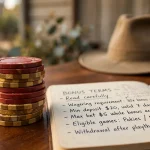
A rules screen can make a dice game sound simple while leaving the money terms somewhere else. I learned to separate those two things. The game rules explain what an outcome means; the promotion terms explain whether a bonus can be withdrawn, and when. They are not interchangeable.
Start with the stake and payout definitions. Check whether a stated return includes your original stake, what happens if a roll is void or interrupted, and whether the rules treat a tie or an unusual result differently from a standard loss. If the wording does not tell you what happens to your money in each case, it is not clear enough to rely on. I would not fill in the gaps by guessing.
Then look for limits and restrictions that apply to the account or offer. A bonus is not cash sitting in your balance: bonus funds are conditional, and winnings derived from them may be subject to wagering checks before withdrawal. Read which games count, whether dice games are excluded or contribute differently, and whether a maximum stake applies while the bonus is active. A rule that looks small can change whether a balance is withdrawable.
Best Progressive Jackpot Slots: How They Work
The figures can be substantial. One specialist review describes a particular offer with a 40x wagering requirement on a $100 bonus: that would mean $4,000 in bets before bonus-derived winnings could be withdrawn. That is an illustration of one offer, not a general rule for casino dice. Affiliate reviews also describe wagering requirements in the 30–50x range, but those are reported terms, not a promise about any specific offer or a market-wide standard. Check the actual terms attached to the offer.
I also look for the definition of “wagering requirement” itself. Does it apply to the bonus, the bonus plus a deposit, or another stated amount? When does the clock start, and what happens if the offer expires before the requirement is met? If the answer is buried in separate terms, read those too. “Bonus” is the sales word. Conditions are the real part.
For Australians, this is not a recommendation to claim an online casino offer. The Interactive Gambling Act 2001 prohibits operators from providing real-money online casino games to people in Australia. Understanding the wording does not make an offer lawful or remove its restrictions.
Bonus Terms
Bonus funds are conditional, and winnings derived from them may be subject to wagering requirements (e.g., 30–50x) before they can be withdrawn.
If the rules and money terms conflict, or the withdrawal conditions are unclear, stop there. Confusion is not a favourable term.
Dice Strategy: Keep Risk in View
I used to treat a strategy as a way to make a bad session turn around. It isn’t. A betting pattern can change how quickly your balance rises or falls, but it cannot make the dice produce a result you need. If an outcome is random, a run of one result does not make a different result “due”. The dice have no memory.
That is the part casino dice strategy talk tends to dress up. “Control” often means choosing how much to stake and when to stop—not controlling the result. A plan can help you avoid making decisions in the heat of the moment, but it does not remove the game’s risk or guarantee a return. I learned that distinction after confusing a tidy staking plan with an edge. It wasn’t one.
Pokies & Games: Slots and Casino Games in Australia · Live Baccarat Online in Australia: Offshore Casino Guide · 5-Reel Slots in Australia: Formats and Free Play · Lightning Link Online Pokies in Australia: Venue or Online?
Before taking part in any dice game at a casino, decide what you can afford to lose without affecting rent, bills, food or other commitments. Treat that amount as a hard boundary, not a target you need to use up. Set a time limit too, and stop when either limit is reached. Don’t borrow to keep playing, raise stakes to recover losses, or count a previous loss as a reason to continue. A losing session is not a debt the next roll owes you.
It also helps to notice your own signals: hiding play, feeling tense or irritable, or repeatedly breaking limits are reasons to step away and talk to someone you trust. Gambling can cause serious harm, particularly for people who are vulnerable or already under financial or emotional pressure. Asking for support is sensible, not a failure.
You must be at least eighteen to gamble. If gambling is becoming difficult to control, Gambling Help Online can provide support in Australia. I wish I’d taken the warning signs seriously earlier.
Crash Casino Games in Australia: Access and Risks
Keep the strategy modest: choose a boundary, understand that chance remains in charge, and be willing to stop. No system can promise a win or erase what has already been lost. That’s the plain version.
Live Dice: What the Format Changes
“Live” describes how a dice game is presented, not a special set of rules. The game may show a real table and a presenter through a video stream, while the betting interface and outcome information appear on screen. That can make the experience feel closer to a physical table, but the label alone tells you little about how the game works.
I’d pay attention to what the screen actually explains. Can you see when betting opens and closes? Does it show the dice result clearly, and explain how that result settles each available bet? Are the relevant rules visible before any money is committed? If those details are hard to find, a polished stream doesn’t make the conditions clearer. Nice production, same unanswered questions.
Mines casino game in Australia: what to verify · 3-Reel Slots in Australia: Rules and Versions · Seven-Reel Slots in Australia: Features and RTP · Pokies Tips and Tricks: What Actually Affects Your Odds
Also separate the live video from the mechanics. A presenter may roll physical dice, but you still need to know how the game records the result and what happens if the stream or connection is interrupted. Check whether the displayed rules explain those situations, rather than assuming the format will sort them out.
“Live” can sound like a quality guarantee. It isn’t. A camera feed does not, by itself, establish that the rules are fair, that the outcome is easy to verify, or that a game is suitable for you. Those are separate questions, and the screen should give you enough information to understand the conditions without relying on the host’s commentary.
There is an important Australian limit, too: real-money online casino games, including live dice formats, cannot lawfully be offered to people in Australia under the Interactive Gambling Act 2001. So this is a way to understand what the format means, not a recommendation to seek out or use a service. If gambling is causing harm to you or someone close to you, support is available through Gambling Help Online.
Pokies

3-Reel Slots in Australia: Rules and Versions
A practical look at game versions, bonus triggers, paytables, free play and the limits of...

5-Reel Slots in Australia: Formats and Free Play
A clear guide to five-reel layouts, independent RNG results, free play, and the limits of...

Seven-Reel Slots in Australia: Features and RTP
A practical look at bonus mechanics, RTP context, free play and why reel labels alone...

Bonus Buy Slots in Australia: Rules, Risks and Demos
Understand offshore casino risks, compare game versions and use demos to test bonus-buy features before...

High-volatility slots in Australia: how they work
High volatility means less frequent, potentially larger wins, but it cannot predict the outcome of...

Low-Volatility Slots in Australia: How They Play
Low volatility usually means more frequent, smaller wins, but every spin remains uncertain and outcomes...

Pokie Machines to Play in Australia: Legalities and Odds
A practical look at legality, game features, odds, demo limits and payment cautions across online...

Best Progressive Jackpot Slots: How They Work
Progressive prizes grow through wager contributions, but eligibility, bet rules and random outcomes shape how...

Best RTP Slots in Australia: What the Figure Means
RTP describes an expected pattern across millions of spins, not the result of an individual...

Video Slots in Australia: Online Play Explained
Explore mobile and desktop play, free spins, bonus mechanics, legal checks and RTP, while keeping...

Crash Casino Games in Australia: Access and Risks
Crash games revolve around a rising multiplier and a cash-out decision, but the label alone...
Lightning Link Online Pokies in Australia: Venue or Online?
Lightning Link is a venue machine series, while online claims, virtual credits, game variants and...

Live Baccarat Online in Australia: Offshore Casino Guide
A practical overview of offshore platforms, live and RNG tables, baccarat rules, payments, and the...

Live Blackjack Online in Australia: Legal Context
Australian-licensed operators cannot offer online casino games, so branding and payment options do not establish...

Live Roulette in Australia with English-Speaking Dealers
A practical overview of Australian online-gambling rules, roulette odds, table terms and the limits of...

Mines casino game in Australia: what to verify
Search terms such as “slot,” “demo” and “review” do not confirm a specific game, provider...

Plinko Casino in Australia: Slots, Access and Risk
The name alone does not explain a game's format, access conditions, cashouts or the limits...

Pokies Tips and Tricks: What Actually Affects Your Odds
Random spins, wagering terms, RTP checks and session limits put common pokies advice into perspective....

Real Money Casino Table Games in Australia
Learn how live-dealer streams differ from RNG games, and what the guide can establish about...