Pokies Tips and Tricks: What Actually Affects Your Odds
 Available in AU

Random spins, wagering terms, RTP checks and session limits put common pokies advice into perspective.
Table of Contents
- Why No Pokies Trick Can Make a Win More Likely
- What Australian Players Need to Know About the Rules
- Bonus Maths: Read the Wagering Terms Before You Play
- The Machine Does Not Remember Your Last Spin
- Playing Dragon Link Without Treating It Like a System
- Winning on Pokies: Keep the Odds in Perspective
- Set a Session Budget Before You Open a Game
- Keep Online Pokies in the Entertainment Budget
- 5 Dragons: Apply the Same Odds, Not a Special Trick
- Check the RTP on the Game’s Information Screen
Why No Pokies Trick Can Make a Win More Likely
I used to think there had to be a knack to it. Not a grand secret, just some small edge I hadn’t noticed yet: play at a certain time, stick with a machine after a dry spell, or change the bet when the game seemed ready to pay. Those ideas can feel convincing when a win arrives right after you try something. But a lucky result is not proof that the trick caused it.
Each spin on a pokie is random and independent of the spins before it. A win does not make another win more likely, and a run of losses does not mean the game owes you a payout. The previous result gives you no reliable clue about the next one. That’s the part I found hardest to accept, because people are good at spotting patterns—even when the pattern is just coincidence.
Why familiar systems feel convincing
A system can make play feel orderly. You might decide to raise your bet after a loss, lower it after a win, or leave once you reach a particular result. Following a rule gives you something to do, and it can make a session feel less random. But changing your behaviour does not change the underlying chance of the next spin paying.
When choosing where to play pokies, check the details that matter to you before depositing. This list offers a quick reference to the available operator information for 2026.
1. JustCasino
License: Curacao Gaming Control Board JustCasino is listed with a licence from the Curacao Gaming Control Board. You can use that detail as one point of reference when assessing the operator.
2. MrPacho
Payout speed: crypto 30-120 minutes, fiat 24-72 hours · Min. deposit: A$30 MrPacho lists crypto payouts at 30–120 minutes and fiat payouts at 24–72 hours. Its minimum deposit is A$30, giving you two concrete details to consider before playing.
3. Roby Casino
License: Curacao eGaming (Roby Games Ltd) Roby Casino is listed under a Curacao eGaming licence held by Roby Games Ltd. You can take note of the named licence holder when reviewing the operator.
4. WinSpirit Casino
License: Curacao eGaming OGL/2024/923/0383 (Antillephone N.V.) · Min. deposit: A$30 WinSpirit Casino lists Curacao eGaming licence OGL/2024/923/0383, issued through Antillephone N.V. Its minimum deposit is A$30.
5. DragonSlots Casino
License: Curacao Gaming Authority (Jumpman Gaming Ltd) DragonSlots Casino is listed with a Curacao Gaming Authority licence held by Jumpman Gaming Ltd. You can use the licensing information as a reference when considering it.
6. SpinsUp
License: Curacao Gaming Control Board OGL/2023/174/0082 (Dama N.V.) SpinsUp lists Curacao Gaming Control Board licence OGL/2023/174/0082, held by Dama N.V. That licence detail is the available point of reference for this operator.
7. SkyCrown
License: Tobique Gaming Commission · Payout speed: crypto ~10-15 minutes, fiat 1-5 days · Min. deposit: A$30 SkyCrown lists a Tobique Gaming Commission licence and crypto payouts of about 10–15 minutes; fiat payouts are listed at 1–5 days. Its minimum deposit is A$30.
8. Neospin
License: Curacao Gaming Control Board OGL/2023/176/0095 (Hollycorn N.V.) Neospin lists Curacao Gaming Control Board licence OGL/2023/176/0095, held by Hollycorn N.V. You can note those licence details when reviewing the operator.
9. Wild Tokyo
License: Curacao · Payout speed: crypto 30-60 minutes, fiat 1-5 days · Min. deposit: A$10 Wild Tokyo lists a Curacao licence, crypto payouts of 30–60 minutes and fiat payouts of 1–5 days. Its minimum deposit is A$10.
10. Uptown Pokies
License: Curacao (operating since 2017) · Min. deposit: A$20 Uptown Pokies is listed as operating since 2017 and has a Curacao licence. Its minimum deposit is A$20.
The same goes for timing. There is no special hour when a pokie becomes more generous, and waiting for a quiet moment does not improve the odds. A lucky charm can make the experience more personal, but it cannot affect the result either. I’ve tried reading meaning into all of these things. The meaning was mine; the outcome was still chance.
That distinction matters. You can choose when to play and what bet size feels manageable, but those choices are not a way to make a win more likely. They shape your experience, not the machine’s odds. Not the same thing.
A near miss can be especially persuasive. The symbols may look as if they almost lined up, and it is natural to think you are getting closer. But “almost” is a description of what you saw, not evidence that the next spin is due to finish the pattern. Treating it as a signal can keep you chasing a result that has no reason to arrive.
What a “winning tip” can and cannot do
Some advice is useful because it helps you make decisions about your own play. You can decide in advance what you are comfortable spending, or stop when you no longer want to continue. Those are boundaries, not winning systems. They can help prevent a session from taking over your evening, but they do not improve the chance of a payout.
That is where the wording around tips can get slippery. “Play smart” sounds as if it must mean finding an advantage. Often, the practical meaning is simply to make choices with a clear head and not mistake a good run for a repeatable method. There is no harmless little adjustment that turns a pokie into a reliable way to make money.
Bonus Buy Slots in Australia: Rules, Risks and Demos · Casino Dice Games in Australia: Rules and Formats
The maths is blunt: every pokies strategy has negative expected value because the house edge favours the game over time. That does not mean every spin loses, or that a player cannot land a win. It means a win is possible without being something a system can reliably produce. A strategy may change how you play, but it cannot remove that built-in disadvantage or create positive expected value.
I once treated a winning session as confirmation that I’d finally worked something out. Then I used the same approach and lost. The first outcome had felt like evidence; the second was a reminder that a short run can go either way. Neither result proved the system worked. I wanted it to.
Keep the claim smaller than the promise
When someone describes a method as a sure route to a payout, be wary of the promise. A method may sound precise because it gives you steps to follow, but precision is not the same as an edge. If it relies on timing, a lucky object, a pattern in recent results, or a rule for changing bets, it still cannot make the next spin more favourable.
You can enjoy a pokie without believing you have decoded it. That is a more honest starting point than searching for a magic sequence. If you play, think of the result as uncertain every time, not as a reward that becomes more deserved after a streak of losses or more likely after a previous win.
Do
- Set a budget you are comfortable spending
- Stop when you no longer want to continue
- Treat the result as uncertain every time
Don’t
- Search for a magic sequence or trick
- Believe that a payout is “due” after losses
- Rely on timing or lucky charms to win
I still understand the appeal of a clever trick. It would be nice if there were a way to keep the fun and tilt the odds in your favour. But hoping for that edge is not the same as having one. The most useful tip is not a secret move: it is knowing that no move can promise a win.
What Australian Players Need to Know About the Rules
“Pokies” is the Australian word for slot machines. You’ll hear it in pubs and clubs, and it is also the familiar term people use when talking about online slots. But the same word does not mean the same rules apply everywhere. In Australia, the key distinction is between a player’s position and the rules governing businesses that provide online casino games.
The Interactive Gambling Act 2001 prohibits operators from providing real-money online casino games to people physically located in Australia. That category includes online pokies, as well as games such as roulette, blackjack and online poker. The restriction is aimed at the service provider, not at making an individual player criminally liable simply for playing at an offshore casino. That difference matters, but it does not make an offshore site an Australian-regulated service.
Real Money Casino Table Games in Australia
I used to see the word “licensed” and treat it as a shortcut for “safe to use here”. It isn’t. A licence issued in another jurisdiction does not authorise an operator to provide real-money online casino games to people in Australia. A foreign licence may describe the operator’s status under that regulator; it does not override Australian law or turn the service into a locally licensed casino.
That’s the part worth keeping straight when reading anything about Australian pokies. A page may use phrases such as “available to Australian players” or “Australian-friendly”, but marketing language cannot change what the law says about the operator’s service. Nor does a list of foreign licensing jurisdictions establish that online casino play is legal for providers in Australia. The label and the legal position are different things.
The Act sets a maximum daily penalty of $360,000 for an individual who violates it and $1.8 million per day for a body corporate. Those penalties concern people or companies that breach the law; they are not a fine imposed on a player merely for accessing an offshore casino. I’d be wary of any explanation that blurs those two groups together or uses the penalties to suggest that a player faces the same exposure as an operator.
5-Reel Slots in Australia: Formats and Free Play
There is another practical wrinkle: offshore online casino services are subject to active blocking and enforcement in Australia. So a site appearing in a search or being mentioned in a review is not proof that it is authorised, reliable, or consistently accessible from here. A blocked page, a change of web address or a payment claim in promotional copy does not settle the legal question. I wouldn’t treat a working link as a green light.
It also helps to separate the familiar local use of “pokies” from the location of the service. A physical gaming machine and an online casino site are not interchangeable just because both are described with the same word. The legal rule discussed here concerns online interactive gambling services offered to people in Australia. It is not a general endorsement of every activity called gambling, and it is not a recommendation to look for an offshore site.
Legal Warning
The Interactive Gambling Act 2001 prohibits operators from providing real-money online casino games to people physically located in Australia.
When I check a claim about the rules, I look for what it actually says about the provider, the player and the jurisdiction issuing any licence. If those are all mashed into one confident sentence, it’s hard to tell what is being claimed. “Licensed” may sound reassuring, but the useful question is: licensed by whom, for what conduct, and does that make the service lawful to provide in Australia? For online real-money pokies, the Australian rule for operators is clear: they cannot provide that service to people here.
So, if you’re trying to understand the Australian context, start with the law rather than a site’s sales pitch. The player is not criminally liable merely for playing at an offshore casino, while the operator is prohibited from supplying real-money online casino games to people physically in Australia. A foreign licence does not change that. Keep those points separate, and it becomes much easier to read claims about online pokies without mistaking access, advertising or an overseas licence for Australian authorisation.
Bonus Maths: Read the Wagering Terms Before You Play
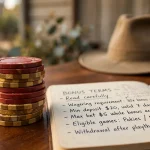
A bonus can look like money in your account, but the headline figure is not the same as cash you can withdraw. The wagering requirement is the part that tells you how much betting is attached to the offer. I learned to look there first; the bright “free” label tends to do a lot of work.
The calculation is straightforward: bonus amount multiplied by the wagering multiple. A specialist affiliate review describes a A$100 bonus with a 40x requirement, which comes to A$4,000 in total bets before the requirement is met. That is turnover, not a bill you pay once, and it does not mean you will have A$4,000 left afterwards. Each bet can change your balance, and the bonus may have other conditions as well.
High-volatility slots in Australia: how they work
A separate specialist affiliate review gives a A$100 bonus with a 30x requirement. The arithmetic is A$100 multiplied by 30, or A$3,000 in required betting. Those examples show why the multiple matters as much as the advertised amount. They are examples from reviews, not a promise that every offer uses those terms.
Free spins need the same careful reading. Any winnings they produce may be real, but the terms can still require further betting before you can withdraw them. A specialist affiliate review describes wagering requirements in the 20–40x range for free-spin winnings; that range is its report, not a fixed rule for every promotion. Check what amount the multiple applies to: the bonus, the winnings, or another defined figure. If the wording is unclear, do not assume the smallest interpretation.
I also check whether the bonus has a maximum bet condition while wagering is active. One specialist affiliate review reports that offers may impose a per-spin cap and that exceeding it can forfeit the bonus. The exact condition belongs to the specific offer, so read its terms before playing rather than relying on a number from another promotion. A small detail in the rules can decide whether your progress counts.
Then look for limits on eligible games, expiry conditions and withdrawal rules. These are not decorative footnotes. If a game does not contribute to wagering, spins on it may not move the requirement along. If a deadline applies, unfinished wagering may affect what happens to the bonus or related winnings. I have clicked past those details before and only noticed later that I had misunderstood what counted.
Calculating Wagering
Step 1: Identify the values
Find the bonus amount and the wagering multiple (e.g., A$100 bonus with a 40x requirement).
Step 2: Multiply the figures
Multiply the bonus amount by the multiple: A$100 × 40 = A$4,000.
Step 3: Determine the total turnover
The result is the total amount of bets you must place before the bonus is met.
The useful comparison is not “big bonus” against “small bonus”. It is the amount offered against the total betting required, plus the restrictions attached to that betting. A bonus with a large headline can demand substantial turnover; a smaller one can still carry conditions that make it unsuitable for you. And completing the requirement does not guarantee a profit.
I now treat a promotion as a set of conditions, not extra spending money. Read the full terms, work out the total turnover, and decide whether you are comfortable with the requirement before accepting anything. If the maths or wording does not make sense, leaving the offer alone is a perfectly sensible choice.
The Machine Does Not Remember Your Last Spin
A run of losses can make the next spin feel overdue. A run of wins can make it feel as if you have found a rhythm. I have fallen for both impressions. Neither tells you what comes next: each spin is random and independent of the results before it.
That independence is the bit our brains resist. We notice patterns, especially when money is involved, and a sequence can look like a clue. But a pokie does not build a memory of your session. A loss does not make a win more likely on the next spin, and a win does not make another win due. The previous result is history, not a forecast.
What an RNG does — and does not — tell you
A random number generator, or RNG, is the system used to produce game outcomes. Where a gaming system carries eCOGRA or GLI certification, that is relevant information about the technology behind it. It is not a promise that a particular spin will pay, that a session will be fair to your balance, or that you can identify a favourable moment to play.
Mines casino game in Australia: what to verify
I used to treat a machine’s recent results like a conversation: it had been quiet, so surely it was about to give something back. That story felt convincing while I was watching the screen. It still had no power over the next result. The machine had no idea what I had lost, and it was not keeping score for me.
That matters when people talk about “hot” or “cold” machines. Those labels describe what a player has just seen, not a dependable change in the next spin’s odds. Changing your timing, bet size or routine cannot make the RNG produce the result you want. A streak can continue, stop or reverse; its shape alone does not reveal which.
No signal there.
Transparency is not a prediction tool
A certification mark can help you understand that a recognised testing body is associated with the RNG technology. It does not turn randomness into something readable from the outside. Nor does a reported figure from a set of sessions tell you what will happen in your own session. A number can describe observations; it cannot name the next outcome.
One specialist review reported analysis of 6,847 sessions, with a median RTP of 96.2% compared with the declared values. That is a specific analysis, not a promise about every game, operator or player. Even when observed results are compared with a declared RTP, short-term outcomes can differ sharply. RTP is a long-run measure, not a schedule that says when money should come back.
Certification marks from bodies like eCOGRA or GLI provide information about the technology, but they do not allow a player to predict the outcome of any specific spin.
I find it useful to separate two questions. “Is there information about the system?” is one. “Can I use that information to call the next spin?” is another. Certification and session analysis may speak to the first; they do not give you a reliable answer to the second.
So when a few spins seem to form a pattern, take it for what it is: a sequence you have noticed, not a message from the machine. The screen can make a streak feel personal. The RNG does not remember you.
Playing Dragon Link Without Treating It Like a System
Dragon Link can attract the sort of advice that sounds practical: wait for a certain moment, change your bet size, or keep going because the game seems “due”. I’ve been tempted by that kind of thinking myself. It gives a run of spins a storyline, as if the game were leaving clues. But a story is not a signal.
Each spin on a poker machine is random and independent of earlier results. That applies to Dragon Link just as it does to any other pokie. A win does not make another win more likely, and a string of losses does not mean a payout is getting closer. The game has no memory to read and no mood to catch.
That is the main point behind any sensible tips for playing Dragon Link: don’t mistake a personal routine for a way to change the result. You can choose whether to continue, stop, or avoid playing altogether. You cannot use a ritual or a pattern you think you’ve spotted to make the next spin more favourable.
Live Blackjack Online in Australia: Legal Context
I used to make little rules for myself after a run went badly. I’d tell myself to wait, then try again; or decide that a different bet would somehow reset things. It felt like taking control. In reality, I was making decisions based on results that had already happened. They did not tell me what the next spin would do.
A better way to approach the game is to decide what you are comfortable with before opening it, rather than letting the last result make the decision for you. If you notice yourself changing plans because you feel a win must be close, pause. That feeling can be persuasive, but it is not information about the next outcome. Stopping is a real option. So is choosing not to play.
Be wary of advice presented as a “best tip” for Dragon Link when it claims a special sequence, timing window, or bet pattern. Such claims may sound confident, especially when they’re wrapped around someone’s winning story. But one person’s result does not establish a method, and no game-specific routine can make independent spins predictable.
There is a difference between setting a personal boundary and trying to beat the machine. A boundary is about your own choice: how much time or money you are willing to put at risk, and when you will leave. A supposed system says it can steer the outcome. The first can help you keep your decision-making in your own hands; the second offers confidence without control.
I’d keep Dragon Link in the same mental category as any other pokie: a game of chance, not a puzzle with a hidden solution. If you find yourself chasing a pattern, take that as a reason to step back rather than as a clue to continue. No secret sequence. No “due” spin.
Dragon Link Truths
- Each spin is random and independent of previous results
- No ritual or pattern can change the outcome
- A string of losses does not make a payout more likely
- Set personal boundaries rather than trying to beat the machine
Winning on Pokies: Keep the Odds in Perspective
A large prize is easy to picture. The odds behind it are harder to feel. A $5,000 win sounds like a clear target when you see it displayed, but on a $1 poker machine the odds of winning a typical prize of that size are 9,700,000 to 1. That is the scale to keep in mind when a jackpot catches your eye.
I used to treat the prize amount as if it told me something about how reachable the win was. It doesn’t. The number on the screen tells you what the prize could be, not how likely you are to land it. A big figure can make a game feel more promising without making the outcome any less uncertain.
The same goes for stories about someone hitting a jackpot. They describe a result that happened; they do not tell you what is likely to happen on your next spin. A win can be real and still be exceptionally unlikely. Keep those two ideas together.
What the long-run return means
Gaming machines are required to return between 85% and 92% of all money bet over their lifetime. That range describes the broad return across a very large number of bets, not a promise about what will happen to one person. It does not mean you will get that share of your money back during a session, or that a machine will pay out in a neat pattern.
The gap between the total bet and the return is the house edge. Across the long run, the returned share is lower than the amount put through the machine. But you are not playing across the lifetime of a machine. Your own results can land far above or below any long-run figure.
Video Slots in Australia: Online Play Explained
That is why a machine’s return rate is not a personal forecast. It cannot tell you whether your next spin will win, or how much you will have when you stop. A short run may feel generous; another may feel brutal. Neither proves that the next result is due to go one way.
No shortcut around that. “Winning tips” can help you keep the prize and the odds in perspective, but they cannot turn a long-shot outcome into a likely one. The most useful question is not how to make a jackpot happen. It is whether you are comfortable with the possibility that the money you put in will not come back.
I find it helps to read a prize display as a possibility, not a plan. The machine can show a life-changing amount while the chance of reaching it remains tiny. If the prize is what makes the game appealing, pause on the odds too. They belong in the same picture.
Keep the scale straight: a large payout is possible, the chance of a typical major prize can be extremely low, and the long-run return is not a guarantee for you. That isn’t a trick. It’s the maths.
Set a Session Budget Before You Open a Game
I used to decide my budget after I had already started playing. That is a neat way to let the game decide for you. Now I settle on a loss limit first: money I can afford to spend on entertainment, not cash I need for bills or other plans. When it is gone, I stop. No topping up to chase it.
Session Management
- Settle on a loss limit using money affordable for entertainment
- Set a deposit limit before starting the session
- Set a session timer to manage your time
- Decide when to stop before opening the game
A deposit limit can put a boundary around how much money you add. Set it before a session, while you are thinking clearly, rather than raising it in the middle of play. A session timer helps with the other boundary: time. When it goes off, take a break or close the game. Don’t treat a timer as a cue to hurry through more spins.
RTP gives you a way to estimate the average loss associated with a pattern of play. The calculation is:
Expected loss = bet size × number of spins × (1 − RTP)
Use RTP as a decimal in that calculation. The result is an estimate across a large number of spins, not a prediction of what will happen in one session. You could lose more, lose less, or finish ahead. I learned that distinction the hard way: an average is not a personal safety net.
Bet size and spin count both matter. A smaller bet does not make a win more likely, but it reduces the amount exposed on each spin. Fewer spins also mean less money put through the game. Those are ways to manage how quickly your budget is at risk, not ways to improve the odds.
For someone working with a limited session budget, a high-RTP, low-volatility game may produce small wins more frequently and keep play going longer. That can make the balance last, but it does not turn the session into a better bet or guarantee that the money comes back. Longer play still means continued exposure to losses. That’s the trade-off.
3-Reel Slots in Australia: Rules and Versions
I keep the plan simple: choose the amount and time in advance, use limits and a timer, and stop when either boundary is reached. If you find yourself changing those rules to keep playing, step away rather than renegotiating with yourself. A plan only helps if you stick to it.
Keep Online Pokies in the Entertainment Budget
I’ve learned to treat any gambling spend as money already gone, not as a little investment waiting to come back. That shift matters with online pokies: if the cost would sting when spent on a night out or another hobby, it is not spare entertainment money.
Mobile play can feel almost frictionless. A swipe, a tap, another spin; there is less pause to notice how quickly the session is moving. A specialist review points out that this easier interface can increase spin rates, making theoretical losses accumulate faster. It doesn’t change the maths of an individual spin. It changes how quickly you can get through them.
That was one of my own bad habits. I’d pick up my phone for a few minutes, then realise I’d been tapping without really deciding whether I still wanted to play. The screen makes it easy to keep going. Easy isn’t the same as harmless.
If you’re considering online pokies as entertainment, decide beforehand what you’re willing to spend for the experience, and stop when that amount is gone. Don’t top it up because the session feels close to turning around, or because you’re bored and the next spin is one tap away. Those are reasons to pause, not reasons to spend more.
Attention Mobile interfaces can increase spin rates, which may cause theoretical losses to accumulate faster than on other platforms.
A useful test is whether you’d still be content with the session if nothing came back. If the answer is no, the money may be doing a job your entertainment budget can’t afford. Demo play, where available, can let you explore a game without risking money; a specialist review reports that the sites it assessed offered demo modes. Check what is available rather than assuming every game has one.
I don’t think of a phone as a safer place to play. It is simply a faster one, and that pace can quietly turn a planned bit of entertainment into more spending than you meant. Keep the distinction clear. The fun is the experience, not a promise of a return.
5 Dragons: Apply the Same Odds, Not a Special Trick
When people ask me for tips for 5 Dragons, I understand the hope behind it: maybe there is a pattern, a certain moment to start, or a way to tell when a big prize is close. I used to look for those signs too. But a game’s name does not turn its spins into a puzzle you can solve.
Seven-Reel Slots in Australia: Features and RTP
Each spin is random and independent of the ones before it. A string of losses does not make a win due, and a recent win does not mean another is likely to follow. Changing your bet size or waiting for a particular point in a session cannot make the next result more favourable. That is not a 5 Dragons quirk; it is how poker machine spins work.
It also helps to keep the scale of large prizes in view. For a typical $5,000 prize on a $1 poker machine, the stated odds are 9,700,000 to 1. That figure is not a published 5 Dragons prize probability, so it should not be treated as one. It simply shows how distant a large prize can be on a machine, even when the prize is easy to picture.
I have wasted time trying to read meaning into a screen after a run of results. It felt like research. It was just me wanting the next spin to make sense. No special sequence or “hot” moment changes the underlying chance.
Pokies & Games: Slots and Casino Games in Australia
If you are considering 5 Dragons, treat it as entertainment rather than a system to crack. Decide what you are comfortable losing before you begin, and stop when that amount is gone. A tip that promises to make a large win predictable is selling certainty the game cannot provide.
That’s the plain version.
Check the RTP on the Game’s Information Screen
When I compare pokies, I check the RTP on the game’s information screen rather than trusting a label or a vague claim elsewhere. RTP, or Return to Player, describes the share of all bets a game is designed to pay back across millions of spins. It is a long-run measure, not a forecast for your next session.
A higher displayed RTP can be useful when comparing games, but it does not mean you are more likely to get a win right now. A game can return less than its stated RTP over a short run, or more. The figure does not tell you what will happen on an individual spin. That distinction is easy to forget when a number looks precise.
Lightning Link Online Pokies in Australia: Venue or Online?
I used to see a high RTP and read it as “better odds today”. That was wishful thinking. The number describes the game’s overall return pattern across a very large volume of play, not a promise to pay you back a particular amount. No short session can be judged against that long-run percentage.
Before settling on a game, open its information or help screen and look for the RTP value. If you are comparing options, look for pokies with RTP above 96%, then confirm that the figure is actually displayed for the version in front of you. Do not assume a number from a general game description applies to every version.
If the value is hard to find, unclear, or absent, you cannot make a meaningful comparison from that screen. I would not fill the gap with a guess or an advertising phrase. Check the number itself, and keep its meaning in proportion: useful for comparing long-run returns, not a way to predict a result.
Small print matters.
What licence should I look for?
Offshore pokies sites may hold licences from Malta, Gibraltar or Curaçao. A foreign licence does not make the service an Australian-licensed casino.
How often should I update my strategy based on results?
Don’t change your strategy in response to recent wins or losses: each spin is independent, so past results do not predict the next one. No strategy can create a reliable edge over the house.
Are RNG outcomes truly random?
Yes. Each spin is random and independent of previous results; licensed sites use eCOGRA- or GLI-certified RNG technology.
Pokies

3-Reel Slots in Australia: Rules and Versions
A practical look at game versions, bonus triggers, paytables, free play and the limits of...

5-Reel Slots in Australia: Formats and Free Play
A clear guide to five-reel layouts, independent RNG results, free play, and the limits of...

Seven-Reel Slots in Australia: Features and RTP
A practical look at bonus mechanics, RTP context, free play and why reel labels alone...

Bonus Buy Slots in Australia: Rules, Risks and Demos
Understand offshore casino risks, compare game versions and use demos to test bonus-buy features before...

High-volatility slots in Australia: how they work
High volatility means less frequent, potentially larger wins, but it cannot predict the outcome of...

Low-Volatility Slots in Australia: How They Play
Low volatility usually means more frequent, smaller wins, but every spin remains uncertain and outcomes...

Pokie Machines to Play in Australia: Legalities and Odds
A practical look at legality, game features, odds, demo limits and payment cautions across online...

Best Progressive Jackpot Slots: How They Work
Progressive prizes grow through wager contributions, but eligibility, bet rules and random outcomes shape how...

Best RTP Slots in Australia: What the Figure Means
RTP describes an expected pattern across millions of spins, not the result of an individual...

Video Slots in Australia: Online Play Explained
Explore mobile and desktop play, free spins, bonus mechanics, legal checks and RTP, while keeping...

Casino Dice Games in Australia: Rules and Formats
Casino dice games vary in how the roll affects a wager, so understanding the rules...

Crash Casino Games in Australia: Access and Risks
Crash games revolve around a rising multiplier and a cash-out decision, but the label alone...
Lightning Link Online Pokies in Australia: Venue or Online?
Lightning Link is a venue machine series, while online claims, virtual credits, game variants and...

Live Baccarat Online in Australia: Offshore Casino Guide
A practical overview of offshore platforms, live and RNG tables, baccarat rules, payments, and the...

Live Blackjack Online in Australia: Legal Context
Australian-licensed operators cannot offer online casino games, so branding and payment options do not establish...

Live Roulette in Australia with English-Speaking Dealers
A practical overview of Australian online-gambling rules, roulette odds, table terms and the limits of...

Mines casino game in Australia: what to verify
Search terms such as “slot,” “demo” and “review” do not confirm a specific game, provider...

Plinko Casino in Australia: Slots, Access and Risk
The name alone does not explain a game's format, access conditions, cashouts or the limits...
Real Money Casino Table Games in Australia
Learn how live-dealer streams differ from RNG games, and what the guide can establish about...