Mines casino game in Australia: what to verify
 Available in AU

Search terms such as “slot,” “demo” and “review” do not confirm a specific game, provider or play conditions.
Table of Contents
- The Slot-Mines Search: What You’re Actually Looking For
- Mines Casino in Australia: The Legal Reality
- Online Mines Searches and Offshore Sites
- Free Mines Play: What the Search Can—and Can’t—Tell You
- A Mines Demo Is Not the Same as Free Play
- Bonus Codes: Read the Wagering Terms Before You Count the Money
- Real-Money Searches and the Cost of Cashing Out
- Where to Play: Treat Search Results as Unverified
- Mines Strategy and Spribe: What Can Be Verified
- Casino Guru Mines Searches: Check the Claim, Not the Label
The Slot-Mines Search: What You’re Actually Looking For
When “slot” appears beside “Mines”, it can make the subject sound more specific than it is. It might mean someone is trying to find a slot-style game with a Mines label, or simply using casino vocabulary while looking for something else. Those are different possibilities, and the wording alone does not settle which one applies.
I’ve learned not to treat a familiar label as proof of a particular game. A title, a provider name and a game category each tell you different things. If a page says “Mines” and also uses slot-related language, that does not establish that a particular slot exists, who made it, or what its features are. It is a starting point for checking the page, not confirmation.
The same goes for “review”. That word can mean a detailed account of a named game, a general casino overview, or a page that uses the term without showing what was actually examined. Before taking any description seriously, look for the exact game title and the provider attached to it. If those are absent, there may be no clear basis for deciding whether the page is discussing a slot at all.
A category label is not a product description. “Slot” can tell you what kind of game a writer appears to have in mind, but it does not tell you whether the game has reels, what its rules are, or whether it is related to another game called Mines. I would not fill those gaps by guessing. Two games can share a word in their names and still have no meaningful connection.
Video Slots in Australia: Online Play Explained
That distinction matters when a page puts a game name next to a provider name. A provider reference is useful only if it is tied clearly to the specific title being described. A list of familiar studio names elsewhere on the page proves nothing about a Mines-branded slot. Nor does a logo, a thumbnail or a heading on its own tell you what the game does. The detail has to match the title.
Even a stated return figure needs careful reading. KA Gaming slot RTP percentages typically fall within a range from 94% to 96%, but that general information does not identify the return of any particular game. It would be a mistake to transfer a provider-level range to a title simply because the provider’s name appears nearby. The specific game and its own stated information matter. A number without that link is easy to overread.
“Login”, “app” and similar labels can also sit beside slot wording without confirming a specific slot offering. They might describe an account page, a mobile service, or a general casino feature. They do not establish that there is a standalone Mines slot, that a named title is available through an app, or that the page has checked any of those details. I’d keep the claim narrow: the wording signals what the page wants to be associated with, not what it has demonstrated.
Plinko Casino in Australia: Slots, Access and Risk · Lightning Link Online Pokies in Australia: Venue or Online?
A “bonus” label is no stronger evidence of a slot title. It may be attached to a promotion or a casino page rather than to any game in particular. I’m not going to treat that as proof that a particular slot has its own offer or that a game’s mechanics have been checked. The label and the underlying claim are separate things.
The practical test is simple: does the page identify one specific game and connect its details to that game? If it does not, keep the conclusion modest. You may be looking at broad casino wording, a loose category description, or a page that has combined terms without establishing a real product relationship. That is not a reason to assume the page is false; it is a reason not to supply missing details yourself.
I’ve done that before: seen a confident heading and mentally added the missing evidence. It saves a few seconds, then leaves you believing more than the page actually showed. A title is not a feature list. A provider mention is not a verified relationship. And slot-related wording does not, by itself, establish what Mines game is being described.
So when slot language appears around Mines, separate the label from the claim. Look for a named title, a clearly attributed provider and details that belong to that exact game. If those links are not there, the safest reading is that the page has used slot terminology—not that it has established a specific slot offering.
Mines Casino in Australia: The Legal Reality
If you’re looking for a casino to play Mines in Australia in 2026, use this list as a starting point for checking the details disclosed about each operator. Consider the licensing and payment information available before deciding where to play.
1. JustCasino
License: Curacao Gaming Control Board JustCasino is listed with a Curacao Gaming Control Board license. You can use that licensing detail as one point of reference when assessing the operator.
2. MrPacho
Payout speed: crypto 30-120 minutes, fiat 24-72 hours · Min. deposit: A$30 MrPacho lists a minimum deposit of A$30. Its stated payout speeds are 30–120 minutes for crypto and 24–72 hours for fiat.
3. Roby Casino
License: Curacao eGaming (Roby Games Ltd) Roby Casino is listed with a Curacao eGaming license under Roby Games Ltd. You can consider this licensing information when reviewing the operator.
4. WinSpirit Casino
License: Curacao eGaming OGL/2024/923/0383 (Antillephone N.V.) · Min. deposit: A$30 WinSpirit Casino lists a Curacao eGaming OGL/2024/923/0383 license through Antillephone N.V. Its stated minimum deposit is A$30.
5. DragonSlots Casino
License: Curacao Gaming Authority (Jumpman Gaming Ltd) DragonSlots Casino is listed with a Curacao Gaming Authority license under Jumpman Gaming Ltd. This gives you a specific licensing detail to consider.
6. SpinsUp
License: Curacao Gaming Control Board OGL/2023/174/0082 (Dama N.V.) SpinsUp lists a Curacao Gaming Control Board OGL/2023/174/0082 license under Dama N.V. You can take that information into account when assessing the operator.
7. SkyCrown
License: Tobique Gaming Commission · Payout speed: crypto ~10-15 minutes, fiat 1-5 days · Min. deposit: A$30 SkyCrown lists a Tobique Gaming Commission license and a minimum deposit of A$30. Its stated payout speeds are around 10–15 minutes for crypto and 1–5 days for fiat.
8. Neospin
License: Curacao Gaming Control Board OGL/2023/176/0095 (Hollycorn N.V.) Neospin is listed with a Curacao Gaming Control Board OGL/2023/176/0095 license under Hollycorn N.V. You can use this as a reference point when reviewing the operator.
9. Wild Tokyo
License: Curacao · Payout speed: crypto 30-60 minutes, fiat 1-5 days · Min. deposit: A$10 Wild Tokyo lists a Curacao license and a minimum deposit of A$10. Its stated payout speeds are 30–60 minutes for crypto and 1–5 days for fiat.
10. Uptown Pokies
License: Curacao (operating since 2017) · Min. deposit: A$20 Uptown Pokies lists a Curacao license and has been operating since 2017. Its stated minimum deposit is A$20.
The important distinction is between a game’s name and the service offering it. In Australia, the Interactive Gambling Act 2001 restricts operators from providing real-money online casino services to people located here. Casino-style games—including poker, blackjack, roulette and slots—are covered when offered as interactive gambling services to Australian customers. Calling a product a “game” does not, by itself, change the legal position.
I used to treat a working website as a kind of quiet approval. That was a bad shortcut. Whether a page loads is not the same question as whether an operator is allowed to provide the service. The law is directed at the providers; Australian players are not criminalised simply for using an offshore site. Those are separate points, and mixing them up makes the rules harder to understand.
The Act is not just a statement of policy. It gives the federal regulator, the Australian Communications and Media Authority (ACMA), responsibility for enforcing the law and monitoring compliance with federal interactive gambling rules. ACMA’s role is to act on prohibited services and advertising, rather than to certify that an online casino is safe or suitable for an Australian player.
One enforcement tool is access blocking. ACMA can ask Australian internet service providers to block websites that provide prohibited interactive gambling services or advertise them in Australia. A block does not rewrite the law; it is one way the regulator can limit access to material it considers prohibited. Nor should a site disappearing from view be read as evidence that every similar service has been assessed in the same way.
Casino Dice Games in Australia: Rules and Formats
The scale of enforcement is substantial. Since November 2019, ACMA says it has blocked more than 1,455 illegal gambling and affiliate websites after enforcement action. The count includes affiliate sites as well as gambling sites, so it should not be read as a count of casino operators alone. It is a record of blocking actions, not a directory of services or a guarantee about what remains accessible.
There is also a discrepancy in reported withdrawal figures. One version says that more than 210 illegal services have left the Australian market since ACMA began enforcing the rules in 2017; another gives the figure as over 190. Those accounts do not match, so it would be misleading to present either number as an uncontested total. The broader point is that enforcement has prompted services to withdraw, while the figures attached to that result vary.
That matters when you see a confident claim that a casino is “available in Australia.” Available can mean a page appears in a browser, a payment option is displayed, or an operator is actively taking customers. None of those phrases establishes that the service is lawful. The relevant legal question is whether the operator is providing a prohibited online casino service to people in Australia—not whether the site has Australian-looking language or a familiar game title.
Advertising has its own restriction. Promoting prohibited interactive gambling services to Australian audiences is not a safe workaround for the rules that apply to supplying them. ACMA’s ability to seek blocks also covers websites advertising prohibited services. So a polished review, banner or affiliate page should not be mistaken for official approval. Marketing can look reassuring. It is still marketing.
Legal Restriction
Under the Interactive Gambling Act 2001, operators are restricted from providing real-money online casino services to people located in Australia.
For me, the cleanest way to read the law is to keep three things apart: the provider’s conduct, ACMA’s enforcement powers and the player’s position. The Act restricts operators from offering the covered services here; ACMA monitors compliance and can pursue measures such as access blocks; and players are not criminalised merely for using an offshore site. That last point is not an endorsement, and it does not turn the operator’s service into a lawful one.
The word “casino” can make an online product sound ordinary, as if it were just another entertainment app. Legally, the setting matters: real-money casino-style services offered online to people in Australia fall under the Interactive Gambling Act. If a claim about a site leans on its availability, presentation or advertising, I would not treat that as a substitute for the actual rule. A working page proves very little.
Online Mines Searches and Offshore Sites
When someone looks for Mines through an online casino, they may be trying to find a casino-style game on a site that takes Australian payments. Those are two separate things: a payment option can tell you what the operator accepts, but it does not tell you whether the service may legally be offered to people in Australia.
Offshore online casinos often accept Australian payments while operating under licences issued elsewhere. That foreign licence describes the operator’s position in its licensing jurisdiction; it does not make real-money online casino services lawful to provide to people physically located in Australia. The Interactive Gambling Act 2001 prohibits operators from offering those services to Australians. A site taking an Australian payment is not evidence that this restriction disappears.
Crash Casino Games in Australia: Access and Risks
That distinction is easy to miss because a payment page can make an offshore service look locally familiar. You might see a method you recognise and assume the rest has been checked for you. I’ve made that kind of leap with gambling sites: the familiar detail caught my eye, and I let it stand in for an answer it could not give. It cannot establish that the operator is authorised to serve Australians.
A Mines-related casino game does not get a different status simply because its name sounds unlike a conventional table game. If it is provided as a real-money online casino game to someone in Australia, the relevant question is still whether the operator is offering a prohibited interactive gambling service. The wording on a page, the location of a licence, and the payment methods listed do not turn that service into a lawful Australian online casino.
There is also an important distinction between the operator’s legal position and the player’s. Australian players are not criminalised for using offshore sites. That does not mean the service is permitted, locally regulated, or protected by Australian consumer safeguards. The law places the restriction on providing the service; it does not make the player’s use a criminal offence. Those points can both be true.
I find it helps to keep the questions separate. Is the site based offshore? Does it accept Australian payments? Is it permitted to provide real-money casino services to people in Australia? The first two may describe how the site operates, but they do not answer the third. A polished page, an Australian dollar display, or a familiar payment option is not a substitute for that legal distinction.
Do
- Check if the site is based offshore
- Verify if it accepts Australian payments
- Confirm the legal permission to offer casino services
Don’t
- Assume a working page means the service is lawful
- Mistake an offshore licence for Australian authorisation
- Treat Australian dollar displays as a guarantee of legality
Nor does a game being described as an online Mines title establish what it actually offers. The label alone says nothing reliable about its rules, the operator behind it, or whether money is involved. A casino may use similar language for different products, so I would not treat a matching title as proof that two pages refer to the same game or service. Keep the claim narrow.
If you are an adult aged eighteen or over, that age threshold does not change the legal status of an offshore casino service. And legality is not the only concern: gambling can cause serious harm, particularly for people who are vulnerable. If money is already becoming hard to control, stepping away and seeking support matters more than finding another site.
The practical takeaway is plain, if not especially exciting: accepting Australian payments is not the same as having permission to offer online casino games in Australia. An offshore licence is not an Australian authorisation. And the fact that players are not criminalised does not amount to an endorsement or a guarantee of protection. Keep those distinctions in view before treating a casino page as a safe or lawful place to spend money.
Not the same thing.
Free Mines Play: What the Search Can—and Can’t—Tell You
When I see a promise of free Mines play, I don’t take “free” as a complete description. It tells me what someone wants me to expect about cost, but not what the page actually offers. The label might refer to a no-stake game, a practice feature, a promotional hook, or simply wording meant to attract a click. Without checking the actual page, I can’t tell which.
3-Reel Slots in Australia: Rules and Versions
That matters because “free” can describe different things. It may mean you can try a game without depositing money, or it may refer to a version that still asks you to register, share personal details, accept marketing, or move through other conditions. A result calling itself a free casino game does not, by itself, tell you whether you need an account or what happens after you click. Don’t assume there are no strings attached.
I’ve been caught by that kind of wording before: the headline sounded like the whole deal, then the important detail sat somewhere else on the page. Now I read the label as a claim to verify, not a promise. Look for plain answers about whether money is involved, whether registration is required, and whether any terms apply. If those answers aren’t clear before you proceed, the word “free” hasn’t done much useful work.
A search for a free Mines game also doesn’t establish that a particular version exists, works as described, or is safe to use. Search results can lead to pages with similar titles but different content. A screenshot or short description may not reflect what opens when you follow the link. Even a page that looks like a simple game can include links, pop-ups, or requests unrelated to the play itself. I wouldn’t treat the title or preview as confirmation.
The phrase “fake casino” can mean a pretend setting with no real wager, but it can also be a loose way of describing a page that imitates a casino. Those are not the same thing. A fictional look does not prove that a page is harmless, and a game that uses pretend credits is not automatically private or free of account requirements. Check what the page asks you to do, not just the theme it presents.
5-Reel Slots in Australia: Formats and Free Play
There’s another catch: a free label doesn’t tell you what experience you’ll get. It does not establish that the rules, interface, pace, or outcomes match any real-money version. Nor does it show that a balance shown on screen can be withdrawn or converted into cash. If a page leaves that unclear, don’t fill in the blanks with the most appealing interpretation. That’s how a small click becomes a longer detour.
I’d also keep the basic boundary in view: gambling is for adults aged eighteen or older, and a no-cost label is not a reason to ignore age restrictions. If gambling is causing serious harm to you or someone close to you, free access to a casino-themed game may not feel harmless in practice. There’s no shame in stepping away rather than testing whether it feels different this time.
So, what can a free-play label tell you? Only that the page is presenting itself as cost-free in some sense. It cannot confirm the terms, the way the game works, whether personal information is requested, or whether the page is genuinely what its title suggests. I’d check those details before engaging and leave if they remain murky. “Free” is a headline, not proof.
A Mines Demo Is Not the Same as Free Play
When I see someone looking for a Mines demo, I read that as a narrower request than simply wanting to play for free. “Demo” suggests they want to inspect a version presented as a trial: see what the screen looks like, understand the choices, or get a feel for the game without staking money. That is the expectation in the wording, not proof that a particular demo exists or works in a particular way.
Real Money Casino Table Games in Australia
Free play is broader. It can mean any no-cost way of engaging with a game, and the person asking may not care whether it is labelled a demo. The distinction is about what you hope to find: a demo points toward a trial version; free play leaves the format open. Neither phrase, by itself, tells you what is available.
That matters because the word “demo” can sound reassuring. I used to treat labels as if they were a description of what I would actually get. They aren’t. A title or snippet can use the word without establishing whether access is possible, whether the version behaves like a paid one, or whether it has the features you expect. Don’t fill those gaps in for the site.
If you land on a page making a demo claim, read the page itself rather than relying on its label. Check what it says about access and what, precisely, is being offered. If those details are absent or vague, you still do not know whether it matches your idea of a demo. A screenshot or a phrase such as “try it” may set an expectation; it does not settle the practical details.
I find it useful to keep the two intentions separate before deciding what information I’m after. Someone who wants a demonstration may be trying to understand the experience first. Someone seeking free play may simply want a no-cost option, however it is described. Those aims overlap, but they are not interchangeable, and a page that addresses one may not answer the other.
Seven-Reel Slots in Australia: Features and RTP
In Australia, wording alone also cannot tell you whether a particular online offering is permitted or accessible. A demo label is not a guarantee of either. I wouldn’t treat it as a recommendation, a promise of access, or evidence about how the game operates. It is just a label to investigate. Nothing more.
Bonus Codes: Read the Wagering Terms Before You Count the Money
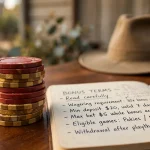
A bonus code can make an offer look like money in your account. It isn’t. Bonus funds are not cash, and any winnings connected to them may come with conditions that have to be met before withdrawal. I learned to stop treating the headline figure as the amount I could actually take out.
That matters whether an offer is described as a promo code, a sign-up bonus or a no-deposit bonus. “No deposit” sounds like there’s nothing to lose, but it does not tell you whether the bonus can be withdrawn, which games count, or what conditions apply to winnings. Those details sit in the terms, not in the label.
The wagering multiplier is one of the first things I check. A specialist review gave this example: a $100 bonus with a 40x wagering requirement calls for $4,000 in bets before bonus-derived winnings can be withdrawn. That is the amount wagered, not a promise that you will win it back or have $4,000 available to withdraw. The distinction is easy to miss when the offer is dressed up as “free” money.
A specialist review also described wagering requirements in the 30–50x range. Treat that as a reported range, not a rule that applies to every offer. The terms for a particular promotion can differ, and the wording may specify whether the multiplier applies to the bonus, the deposit, or another amount. Check the calculation itself rather than assuming.
High-volatility slots in Australia: how they work
Other conditions can matter just as much: which games contribute, whether there is a time limit, and what happens if you withdraw before completing the requirement. If the wording is unclear, you can’t safely work out what the offer allows. I’ve made the mistake of noticing the headline and skimming the small print. That’s how “extra value” turns into a balance you can’t cash out.
Before entering any code, read the full terms and look for the exact wagering base, eligible games, and withdrawal conditions. If those aren’t clear, don’t count the bonus as money you have. It may be a promotional balance with strings attached. The headline is not the payout.
Real-Money Searches and the Cost of Cashing Out
A balance on a screen is not the same thing as money in your account. When I look at cashout terms, I start with the minimum withdrawal: offshore sites commonly set it somewhere between A$75 and A$150. If your balance sits below the stated threshold, you may not be able to request a withdrawal yet. That can make a small win less useful than it first appears.
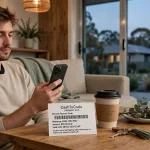
Then there is the first cashout check. KYC documents are commonly requested at that point, such as a passport or driver’s licence plus a utility bill. I would check what the site requires before depositing, and make sure the account details match the documents. Finding out about an extra verification step only after requesting your money is a rotten surprise.
Withdrawal Verification
- Check the minimum withdrawal threshold (commonly A$75–A$150)
- Prepare KYC documents (passport/licence and utility bill)
- Review available payment routes and associated fees
- Verify network fees and conversion spreads for crypto
- Save a copy of the current terms and conditions
Crypto can look appealing because a specialist review describes crypto withdrawals as often clearing fastest. But speed is only one part of the calculation: network fees and the spread used when converting the funds can reduce what arrives. The displayed amount and the amount you receive may differ. Check the applicable fees and conversion method rather than assuming a quick transfer means a cost-free one.
Withdrawal rules are not just small print. Check the minimum, the available payment routes, any fees, and the documents needed for verification before you rely on a balance. Save a copy of the terms you read; conditions can change, and a screenshot gives you something concrete to refer back to if the wording later looks different.
There is also a bigger point I keep in mind: these cashout details describe practices associated with offshore sites, not an endorsement or a suggestion that they are suitable for Australians. Australia prohibits operators from providing real-money online casino services to people in the country. A payment method or a displayed withdrawal option does not change that legal position.
I used to focus on the number shown beside “withdraw” and ignore the path between that button and my bank or wallet. That was backwards. Thresholds, identity checks and deductions decide what can actually be received. Read those terms first. Then decide what the balance really means.
Where to Play: Treat Search Results as Unverified
When you look for a place to play Mines, a results page can make the first few links feel like a shortlist. It isn’t. A prominent result, polished graphics or a confident “lucky” label tells you how a page is presented, not whether its claims are accurate or whether it is appropriate for someone in Australia.
Pokies & Games: Slots and Casino Games in Australia
I used to treat a tidy page as a kind of informal seal of approval. That was a bad shortcut. Search placement is not an independent check of a game, a site’s claims or the rules that apply to Australians. Nor does a familiar name, a copied logo or a page describing itself as “trusted” prove anything on its own. Advertising copy is still advertising copy.
Read the page as a set of claims to examine, not instructions to follow. Does it identify who runs the site? Are its terms available and consistent with what the page promises? Does the wording make clear what is being offered, or does it blur the line between a game description and an invitation to gamble? If basic details are hard to find, don’t fill the gaps with assumptions. Move on from the claim, not toward a deposit.
A search result can also be stale, copied or aimed at readers in another country. A page that appears in Australia is not thereby approved for Australian use. The Interactive Gambling Act 2001 restricts operators from providing real-money online casino games to people physically in Australia, and offshore branding does not change that. This is a reason to be cautious about the result, not a cue to find a workaround.
Low-Volatility Slots in Australia: How They Play
“Lucky” is a mood, not evidence. I know how tempting it is to read a cheerful name as a sign that a site is made for you. It isn’t. Keep your personal and payment details out of any page you cannot assess, and don’t mistake search visibility for protection.
If gambling is causing harm, step away and seek support. Pokies and casino-style gambling can seriously affect vulnerable people; they are not a way to make income. And if you are under eighteen, don’t gamble. Search results don’t make that judgement for you.
Mines Strategy and Spribe: What Can Be Verified
Strategy claims can sound convincing when they are wrapped in confident language: “safe picks”, “patterns” or a system that supposedly turns a run in your favour. I’ve been caught by that kind of certainty before. A tidy explanation is not proof that a method works, and a winning example does not establish that the same choices will produce the same result next time.
Pokies Tips and Tricks: What Actually Affects Your Odds
For Mines, the word “strategy” may refer to choices a player makes, but that label alone tells you nothing about whether a particular approach improves the outcome. Be wary of advice that presents a sequence of decisions as a dependable way to win. Without evidence for the specific game and its rules, there is no sound basis for treating a tip as a tested edge. Confident wording isn’t evidence.
The same caution applies when Spribe is named alongside Mines. Seeing a provider’s name in a title, tag or promotional description does not, by itself, establish that the provider made or supplies the game. Nor does it confirm any particular feature. Check what the page actually says and whether it gives a clear, supportable basis for the association. A name beside a game is not the same thing as proof of a connection.
I would also separate claims about who made a game from claims about how to play it. Even if a provider relationship were clearly established, that would not make a strategy claim reliable. One claim needs evidence about the game’s origin; the other needs evidence that the proposed method does what it promises. They are different questions.
If you are considering gambling, you must be at least 18. I would not treat a strategy label or provider name as a reason to play, or as reassurance that a result can be controlled. Problem gambling can cause serious harm, particularly for vulnerable people. If play is becoming difficult to manage, step away and seek support rather than looking for a stronger system.
I’ve learned to read these claims literally and ask what they actually demonstrate. Sometimes, not much.
Best Progressive Jackpot Slots: How They Work
Casino Guru Mines Searches: Check the Claim, Not the Label
When Casino Guru and Mines appear together in a result, it can look as if the site has reviewed a particular game. I wouldn’t take the pairing at face value. A search-result title or snippet can bring two terms together without establishing that there is a dedicated review, a rating, or any endorsement.
Open the page and check what it actually discusses. Is it about a specific game called Mines, a general game category, or a casino page that happens to mention the word? Those are different claims. A familiar name beside a game title is not evidence that the game was tested.
I’ve learned not to stop at a bold label. Read the page’s own wording: what is being reviewed, what method is described, and whether the conclusion applies to the game itself or to something else. Check the publication or update date too; a page can remain visible after its details have changed. If there is no clear scope or explanation behind a score, the score tells you very little.
The same goes for a result that says Casino Guru has assessed Mines. That wording may be someone else’s summary, not the page’s own claim. Follow it through before relying on it. If the destination does not identify the exact game and explain the basis of its assessment, don’t fill in the gaps yourself.
I’m not saying a named review cannot be useful. I’m saying the label alone does no work. A site name is not a rating, and a rating is not proof of a game’s features or suitability. Read the claim, then decide whether the page supports it.
That’s the check.
Pokies

3-Reel Slots in Australia: Rules and Versions
A practical look at game versions, bonus triggers, paytables, free play and the limits of...

5-Reel Slots in Australia: Formats and Free Play
A clear guide to five-reel layouts, independent RNG results, free play, and the limits of...

Seven-Reel Slots in Australia: Features and RTP
A practical look at bonus mechanics, RTP context, free play and why reel labels alone...

Bonus Buy Slots in Australia: Rules, Risks and Demos
Understand offshore casino risks, compare game versions and use demos to test bonus-buy features before...

High-volatility slots in Australia: how they work
High volatility means less frequent, potentially larger wins, but it cannot predict the outcome of...

Low-Volatility Slots in Australia: How They Play
Low volatility usually means more frequent, smaller wins, but every spin remains uncertain and outcomes...

Pokie Machines to Play in Australia: Legalities and Odds
A practical look at legality, game features, odds, demo limits and payment cautions across online...

Best Progressive Jackpot Slots: How They Work
Progressive prizes grow through wager contributions, but eligibility, bet rules and random outcomes shape how...

Best RTP Slots in Australia: What the Figure Means
RTP describes an expected pattern across millions of spins, not the result of an individual...

Video Slots in Australia: Online Play Explained
Explore mobile and desktop play, free spins, bonus mechanics, legal checks and RTP, while keeping...

Casino Dice Games in Australia: Rules and Formats
Casino dice games vary in how the roll affects a wager, so understanding the rules...

Crash Casino Games in Australia: Access and Risks
Crash games revolve around a rising multiplier and a cash-out decision, but the label alone...

Lightning Link Online Pokies in Australia: Venue or Online?
Lightning Link is a venue machine series, while online claims, virtual credits, game variants and...

Live Baccarat Online in Australia: Offshore Casino Guide
A practical overview of offshore platforms, live and RNG tables, baccarat rules, payments, and the...

Live Blackjack Online in Australia: Legal Context
Australian-licensed operators cannot offer online casino games, so branding and payment options do not establish...

Live Roulette in Australia with English-Speaking Dealers
A practical overview of Australian online-gambling rules, roulette odds, table terms and the limits of...

Plinko Casino in Australia: Slots, Access and Risk
The name alone does not explain a game's format, access conditions, cashouts or the limits...

Pokies Tips and Tricks: What Actually Affects Your Odds
Random spins, wagering terms, RTP checks and session limits put common pokies advice into perspective....

Real Money Casino Table Games in Australia
Learn how live-dealer streams differ from RNG games, and what the guide can establish about...